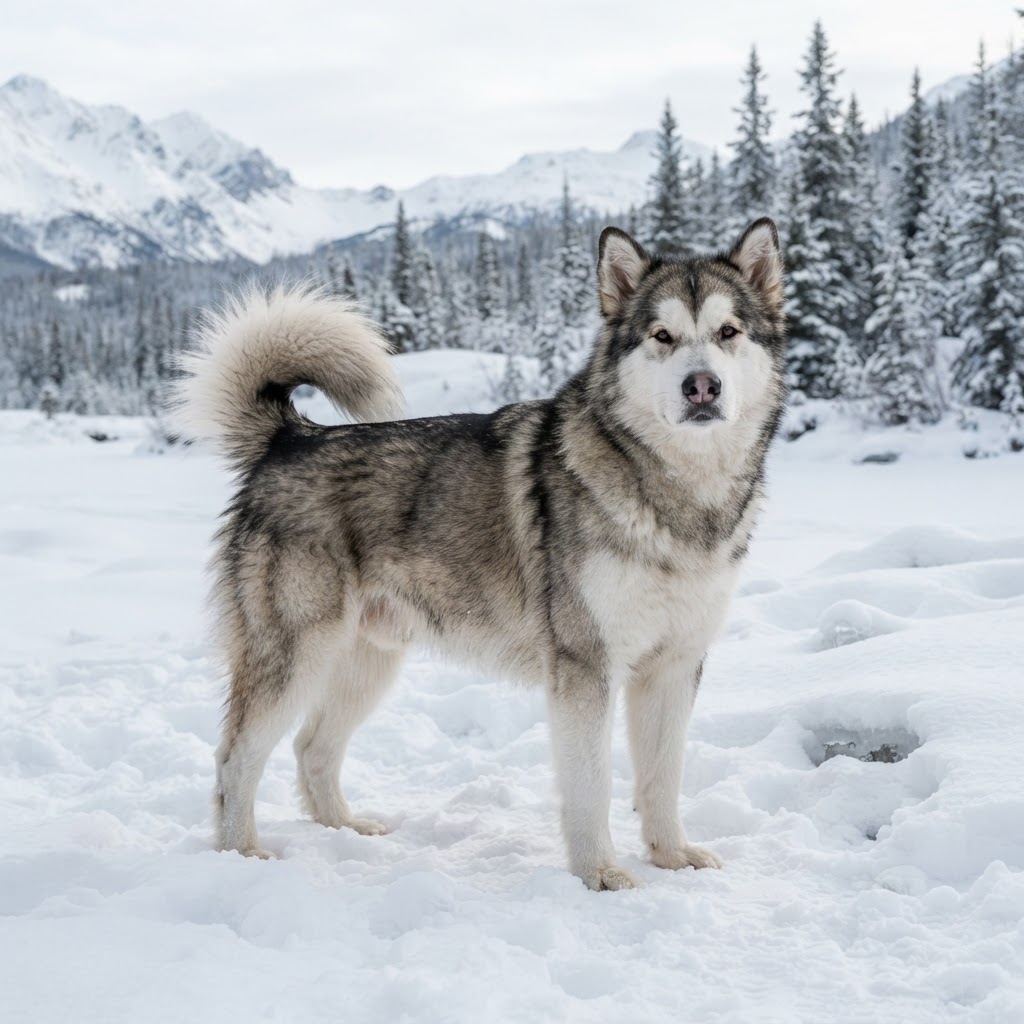
Alaskan Malamute
Male: 38.5 kg, Female: 34 kg
Male: 63.5 cm, Female: 58.5 cm
10–15 years
United States (Alaska)
About the Alaskan Malamute
The Alaskan Malamute is one of the oldest Arctic sled dogs, a powerful and substantially built dog with a deep chest and a strong, compact body. Unlike their cousin the Siberian Husky, which was bred for speed, the Malamute was developed for endurance and strength, capable of hauling immense loads over frozen terrain. They are characterized by their thick, weatherproof double coat and a bushy 'plume' tail carried over the back. Despite their wolf-like appearance, they are famously friendly and affectionate toward humans. In the home, the Malamute is a dignified and loyal companion that thrives on being part of the 'pack' or family. They are known for their 'talking' vocalizations—a series of 'woo-woo' sounds—rather than typical barking. Due to their history as independent workers, they possess a strong-willed nature that requires consistent, patient training from an early age. They are best suited to active families who can provide the physical and mental stimulation this powerful working breed demands.
Breed Standard
Key characteristics from the breed standard
The Alaskan Malamute is a powerful and substantially built dog, heavy in bone relative to other Arctic breeds. The body is compact but not short-coupled, with a deep chest and well-sprung ribs. Balance and overall proportion are essential — the breed must appear neither clumsy nor leggy. Movement is steady, balanced and efficient, with a characteristic tireless, easy stride that reflects the breed's original function as a heavy freighting sled dog, hauling substantial loads over long distances. The head is broad and powerful with a kind expression. The breed's temperament is affectionate, friendly and loyal; the standard specifies that Malamutes should be dignified, never aggressive toward humans.
In Australia
The first Alaskan Malamute was introduced to Australia in early 1978, from the South Island of New Zealand, into South Australia, by Mrs Irene Gates. According to the Alaskan Malamute Club of Victoria Inc., the first Australian litter was born on 18 May 1981.
Bred For
Sled dog for hauling heavy freight over long distances in Arctic conditions
Temperament
Affectionate, friendly, loyal, dignified, and playful, yet independent and strong-willed.
Health Conditions Reported in the Breed
Health conditions reported in the breed include , chondrodysplasia (dwarfism), day blindness (cone degeneration), , , and (). Not all individuals will develop these conditions. Prospective owners should discuss breed-relevant health screening with a registered veterinarian. (Source: Dogs Victoria — Alaskan Malamute breed information.)
Exercise Needs
Individualised daily exercise is essential. As a powerful working breed developed for endurance, the Malamute benefits from regular physical activity and mental stimulation tailored to the individual dog's age, fitness, health and temperament. Suitable activities include walks, hikes, backcountry outings and pulling sports. Owners should work with their veterinarian to establish an appropriate routine, adjusting for climate — Malamutes are susceptible to heat stress and should be exercised during the cooler parts of the day.
Grooming Needs
High; requires daily brushing during shedding seasons and twice-weekly brushing otherwise to manage the dense double coat.
Living Suitability
Best suited to homes with large, securely fenced yards. Prospective owners should be prepared for the breed's high activity needs, heavy seasonal shedding, strong prey drive and vocal tendencies. With appropriate training, socialisation and secure containment, Malamutes can adapt to a range of living situations. Owners in warmer climates must provide adequate shade, cool resting areas and exercise during cooler hours.
Good with Kids
Generally very good with children, being patient and playful; however, their size and strength mean they should be supervised around toddlers.
Good with Other Pets
Can be dominant with other dogs of the same sex and may have a high prey drive toward small animals (cats/rabbits) unless raised with them.
Trainability
Highly intelligent but independent and easily bored; requires firm, consistent, and positive reinforcement-based training.
Coat & Colours
Thick, coarse guard hair with a dense, oily, woolly undercoat. Light grey through intermediate shadings to black, sable, and shadings of sable to red; always with white on underbody and parts of legs/feet/face.
Exercise needs vary by age, fitness, health, weather and individual temperament. Consult your veterinarian for an exercise plan appropriate for your dog.
Things to Consider
Every breed has its quirks — here's what to know
Prospective owners should be aware that Alaskan Malamutes are heavy shedders; they 'blow' their entire undercoat twice a year, resulting in significant amounts of fur around the home. Skin conditions, including zinc-responsive dermatosis, have been reported in the breed; any skin concerns should be assessed by a veterinarian rather than self-managed through dietary changes. Like many deep-chested breeds, they are predisposed to gastric dilatation-volvulus (bloat); feeding multiple small meals and avoiding exercise around feeding times is a practical precaution. Because of their thick coats, they are susceptible to heat stress in Australia's climate; they require shade, cool surfaces and exercise during the cooler parts of the day. They are known as 'escape artists' and 'professional diggers,' meaning they need very secure fencing (often sunk into the ground) and a designated spot to dig. While they don't bark often, their 'woo-woo' howling can be loud and may disturb neighbours if the dog feels lonely or under-exercised. Their high prey drive is a breed trait, so care must be taken around smaller pets. These traits reflect the breed's independent working heritage and require a committed, prepared owner who can provide secure management, consistent training and adequate stimulation.
Feeding Guide for Your Alaskan Malamute
Healthy Weight
32-40 kg
Daily Feeding Amount (general starting estimate)
Approx. 700–1,050 g/day (general starting estimate)
For a healthy adult Alaskan Malamute, a fresh or raw diet should consist of high-quality proteins, organ meats and edible bones. A general starting estimate is approximately 2–3% of the dog's ideal body weight daily — for an average 35 kg Malamute, this equates to roughly 700–1,050 g of fresh food per day. This is a general starting estimate only, not a fixed breed requirement; individual needs vary with age, activity, body condition and health. Dividing the daily portion into two meals is a practical approach for deep-chested breeds. Ingredient percentages alone do not guarantee complete and balanced nutrition — consult a veterinarian for individualised guidance.
Feeding quantities are general starting estimates only. Individual needs vary with body condition, weight trends, age, health and activity. Ingredient percentages alone do not guarantee complete and balanced nutrition — consult a veterinarian for individualised dietary guidance.
Ingredient percentages alone do not guarantee complete and balanced nutrition. Seek veterinary or qualified canine nutrition guidance for individualised dietary advice. Raw feeding, specific proteins or fresh foods should not be presented as preventing, treating or managing breed health conditions without veterinary diagnosis and supervision.
Majestik's Recommended Feeding Approach
Breed Diet Notes
A high-quality, protein-rich diet tailored for large working breeds. Fresh, wholefood ingredients support muscle maintenance, coat condition and overall health. Owners should consult a veterinarian or canine nutrition professional for individualised dietary guidance.
A fresh raw diet for a Malamute may include diverse protein sources such as beef, lamb and kangaroo, combined with edible bone and organ meats. However, ingredient percentages alone do not guarantee complete and balanced nutrition — the appropriate mix should be determined with guidance from a veterinarian or qualified canine nutrition professional. Fresh seasonal vegetables can provide additional nutrients.
These are general breed-level notes only. The appropriate food and serving amount depend on the individual dog's age, health, body condition, activity and tolerance.
Majestik Recommendation
Majestik BARF meals follow our practical 70/10/10/10 approach: approximately 70% quality meat and protein ingredients, 10% edible bone, 10% vegetables and 10% offal. This gives customers a convenient fresh-food option without needing to source and portion every ingredient themselves.
Our Beef, Lamb and Roo BARF meals provide convenient fresh-food options, with suitable proteins chosen or rotated according to the individual dog.
Suitable for different needs
- Healthy adult: Majestik adult Beef, Lamb or Roo BARF meal.
- Puppy: Majestik Premium Puppy.
- Senior: Majestik Senior Blend.
- Working or highly active dog: Suitable Majestik adult meal with quantity adjusted to workload and body condition.
- Protein trial: One Majestik protein at a time.
Recommended Majestik BARF Meals


This is a practical starting recommendation for healthy dogs. Individual needs vary with age, health, body condition and activity.
Alaskan Malamute Feeding Calculator
Personalised raw and cooked feeding recommendations based on your dog's profile
Ideal — Ribs palpable without excess fat. Visible waist. Abdominal tuck present.
Have a question about your Alaskan Malamute? Dog Health AI
Why Majestik?
Fresh, raw pet food made with integrity in South Australia
Australian Made
Made in Two Wells, South Australia
Freshly Prepared
Real meat, organs, bone & wholefood ingredients
No Fillers
No cheap fillers or artificial preservatives
Family Owned
Locally owned and operated
Local Delivery
Delivery across Adelaide & selected areas
Secure Checkout
Secure payment via Shopify checkout
Subscribe & Save on Alaskan Malamute Meals
Get your Alaskan Malamute's fresh and raw meals delivered every two or four weeks. Small subscriptions are combined into a four-week box. Pause, skip or cancel anytime.
Breed Records & Facts
Average Litter Size
6-8 puppies
Alaskan Malamute Owner Feedback
Real experiences and tips from Alaskan Malamute owners
No reviews yet
Be the first to share your experience with this breed
Other Large Breeds
References & Sources
Breed information verified against recognised breed authorities and veterinary evidence.