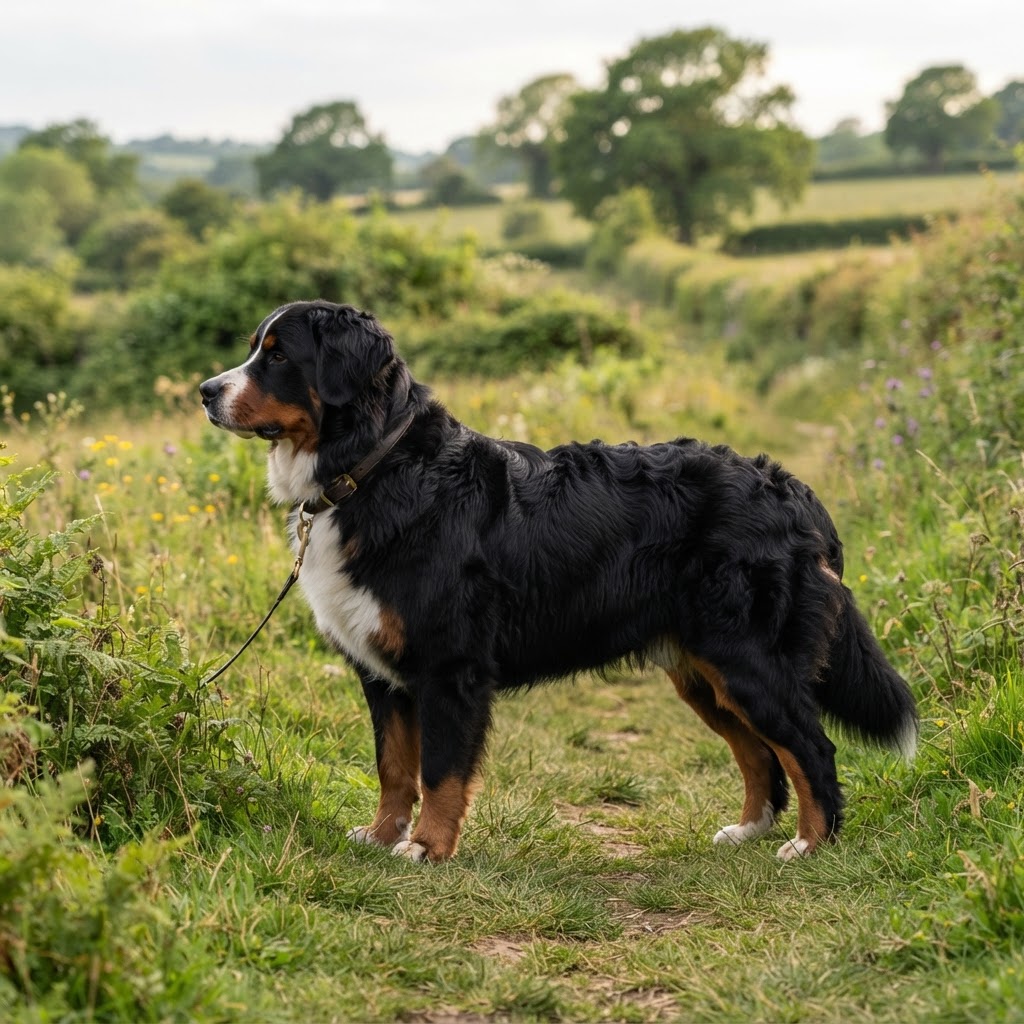
Bernese Mountain Dog
Male: 38-50 kg; Female: 36-48 kg
Male: 64-70 cm; Female: 58-66 cm at the shoulder.
7-10 years
Switzerland
About the Bernese Mountain Dog
The Bernese Mountain Dog is a striking, large-framed working dog originating from the alpine regions of Switzerland. Known for its distinctive tri-colour coat and sturdy build, this breed was the indispensable companion of the Swiss farmer. They possess a unique combination of strength and agility, once used for draught work and driving cattle through rugged terrain. Today, they are cherished primarily as devoted family companions, often referred to as 'gentle giants' due to their remarkably calm and affectionate disposition. Physically, the Bernese is slightly longer than it is tall, possessing a deep chest and a powerful, well-boned frame. Their expression is intelligent and animated, framed by a soft, silky coat that requires regular maintenance. Despite their size, they are known for their 'indoor' manners and desire to be close to their human companions. While they are capable of hard work, they are equally content to relax at their owner's feet, making them one of the most beloved large breeds in Australia.
Breed Standard
Key characteristics from the breed standard
In the show ring, the Bernese Mountain Dog is a portrait of power and harmony. A premier specimen displays a perfectly balanced tricolour pattern, with the white 'Swiss cross' on the chest and a symmetrical blaze on the head being highly prized. Their movement is a distinctive feature: a slow, reaching trot that shows great drive from the hindquarters while maintaining a level topline. What truly distinguishes the Bernese is their 'soft' melting expression and their serene, unshakeable confidence in the ring. They possess a regal presence that combines the utility of a draft dog with the elegance of a companion, making them a standout in the Working Group for their structural soundness and coat lustre.
In Australia
The Bernese Mountain Dog was introduced to Australia in the 1970s, as reported by the Bernese Mountain Dog Club of Victoria. Following this introduction, the first litter of Bernese Mountain Dogs in Australia was recorded in 1974.
Bred For
Originally a multipurpose farm dog used for herding cattle, guarding property, and pulling heavy carts to the dairy.
Temperament
Self-assured, good-natured, docile, and devoted to its family; they are famously affectionate and placid.
Health Conditions Reported in the Breed
Hip and , Histiocytic rcoma (and other cancers), (), Von Willebrand’s Disease (), and ().
Exercise Needs
Moderate exercise: approximately 45-60 minutes of daily walking, supplemented by mental stimulation and occasional hiking or carting activities.
Grooming Needs
Frequent brushing (at least 2-3 times a week) to manage shedding and prevent matting; daily brushing is required during seasonal shedding 'blows'.
Living Suitability
Not suited for apartment living; they require a medium to large fenced yard and thrive in cooler climates due to their thick coats.
Good with Kids
Excellent with children; they are patient and gentle, though their size requires supervision around toddlers to prevent accidental knocks.
Good with Other Pets
Generally very good with other dogs and household pets, especially if socialised from a young age.
Trainability
Highly intelligent and eager to please, though they can be sensitive to harsh corrections; they respond best to positive reinforcement and consistent, gentle guidance.
Coat & Colours
Thick, long, and slightly wavy or straight double coat with a bright natural sheen.. Tricolour: jet black ground with rich russet-brown (tan) on the cheeks, over the eyes, on all four legs and on the chest, and white markings on the head, chest, and paws.
Exercise needs vary by age, fitness, health, weather and individual temperament. Consult your veterinarian for an exercise plan appropriate for your dog.
Things to Consider
Every breed has its quirks — here's what to know
Prospective owners should be aware that Bernese Mountain Dogs are predisposed to several health conditions, most notably Histiocytic Sarcoma (a rapid-onset cancer) and Gastric Dilatation-Volvulus (Bloat) due to their deep chests; while this doesn't mean every dog will be affected, it highlights the importance of regular veterinary check-ups and mindful feeding practices. They are known for a shorter lifespan than many other breeds, which is a significant emotional consideration. Their thick double coats result in heavy shedding, particularly during seasonal changes, and they are prone to 'hot spots' if the coat is not kept dry and well-groomed. Being a large breed, they are susceptible to hip and elbow dysplasia, so maintaining a lean weight is crucial to protect their joints. They are also famous 'slobberers,' especially after drinking or when food is nearby—a small trait for such a loving companion. They can be sensitive to heat, necessitating access to shade and cool water during Australian summers. Finally, they often develop 'separation anxiety' if left alone for long periods, as they truly crave human presence. These traits are part of their 'gentle giant' nature, making them best suited for owners who can integrate them fully into the family home.
Feeding Guide for Your Bernese Mountain Dog
Healthy Weight
36-50 kg
Daily Feeding Amount (general starting estimate)
900-1350 grams
For an adult Bernese Mountain Dog, a fresh food diet should focus on high-quality proteins like beef, lamb, and kangaroo. Some owners use smaller divided meals and avoid strenuous activity immediately around feeding. These steps cannot guarantee prevention of gastric dilatation-volvulus. Seek urgent veterinary care if bloat is suspected. Based on an average weight of 45kg, an adult dog typically requires between 900g and 1350g of fresh food daily, representing approximately 2-3% of their body weight. Adjustments should be made based on individual metabolism and activity levels.
Feeding quantities are general starting estimates only. Individual needs vary with body condition, weight trends, age, health and activity. Ingredient percentages alone do not guarantee complete and balanced nutrition — consult a veterinarian for individualised dietary guidance.
Ingredient percentages alone do not guarantee complete and balanced nutrition. Seek veterinary or qualified canine nutrition guidance for individualised dietary advice. Raw feeding, specific proteins or fresh foods should not be presented as preventing, treating or managing breed health conditions without veterinary diagnosis and supervision.
Majestik's Recommended Feeding Approach
Breed Diet Notes
Supplement suitability and dosage depend on the individual dog’s diet and health. Discuss targeted supplementation with your veterinarian or qualified canine nutrition professional.
A Bernese Mountain Dog thrives on a balanced raw diet consisting of 70% lean muscle meat (such as Majestik's Beef or Kangaroo), 10% edible bone (such as turkey necks or beef brisket), 10% organ meats (liver and kidney), and 10% pureed vegetables (spinach, carrots, and pumpkin). Given their predisposition to joint issues, the inclusion of omega-3 rich fish or green-lipped mussel is highly recommended. For a 45kg dog, aim for approximately 1.1kg of raw food split into two meals. Avoid high-fat proteins to maintain a lean body condition and minimise joint strain.
These are general breed-level notes only. The appropriate food and serving amount depend on the individual dog's age, health, body condition, activity and tolerance.
Majestik Recommendation
Majestik BARF meals follow our practical 70/10/10/10 approach: approximately 70% quality meat and protein ingredients, 10% edible bone, 10% vegetables and 10% offal. This gives customers a convenient fresh-food option without needing to source and portion every ingredient themselves.
Our Beef, Lamb and Roo BARF meals provide convenient fresh-food options, with suitable proteins chosen or rotated according to the individual dog.
Suitable for different needs
- Healthy adult: Majestik adult Beef, Lamb or Roo BARF meal.
- Puppy: Majestik Premium Puppy.
- Senior: Majestik Senior Blend.
- Working or highly active dog: Suitable Majestik adult meal with quantity adjusted to workload and body condition.
- Protein trial: One Majestik protein at a time.
Recommended Majestik BARF Meals


This is a practical starting recommendation for healthy dogs. Individual needs vary with age, health, body condition and activity.
Bernese Mountain Dog Feeding Calculator
Personalised raw and cooked feeding recommendations based on your dog's profile
Ideal — Ribs palpable without excess fat. Visible waist. Abdominal tuck present.
Have a question about your Bernese Mountain Dog? Dog Health AI
Why Majestik?
Fresh, raw pet food made with integrity in South Australia
Australian Made
Made in Two Wells, South Australia
Freshly Prepared
Real meat, organs, bone & wholefood ingredients
No Fillers
No cheap fillers or artificial preservatives
Family Owned
Locally owned and operated
Local Delivery
Delivery across Adelaide & selected areas
Secure Checkout
Secure payment via Shopify checkout
Subscribe & Save on Bernese Mountain Dog Meals
Get your Bernese Mountain Dog's fresh and raw meals delivered every two or four weeks. Small subscriptions are combined into a four-week box. Pause, skip or cancel anytime.
Breed Records & Facts
Average Litter Size
5-7 puppies
Bernese Mountain Dog Owner Feedback
Real experiences and tips from Bernese Mountain Dog owners
No reviews yet
Be the first to share your experience with this breed
Other Large Breeds
References & Sources
Breed information verified against recognised breed authorities and veterinary evidence.