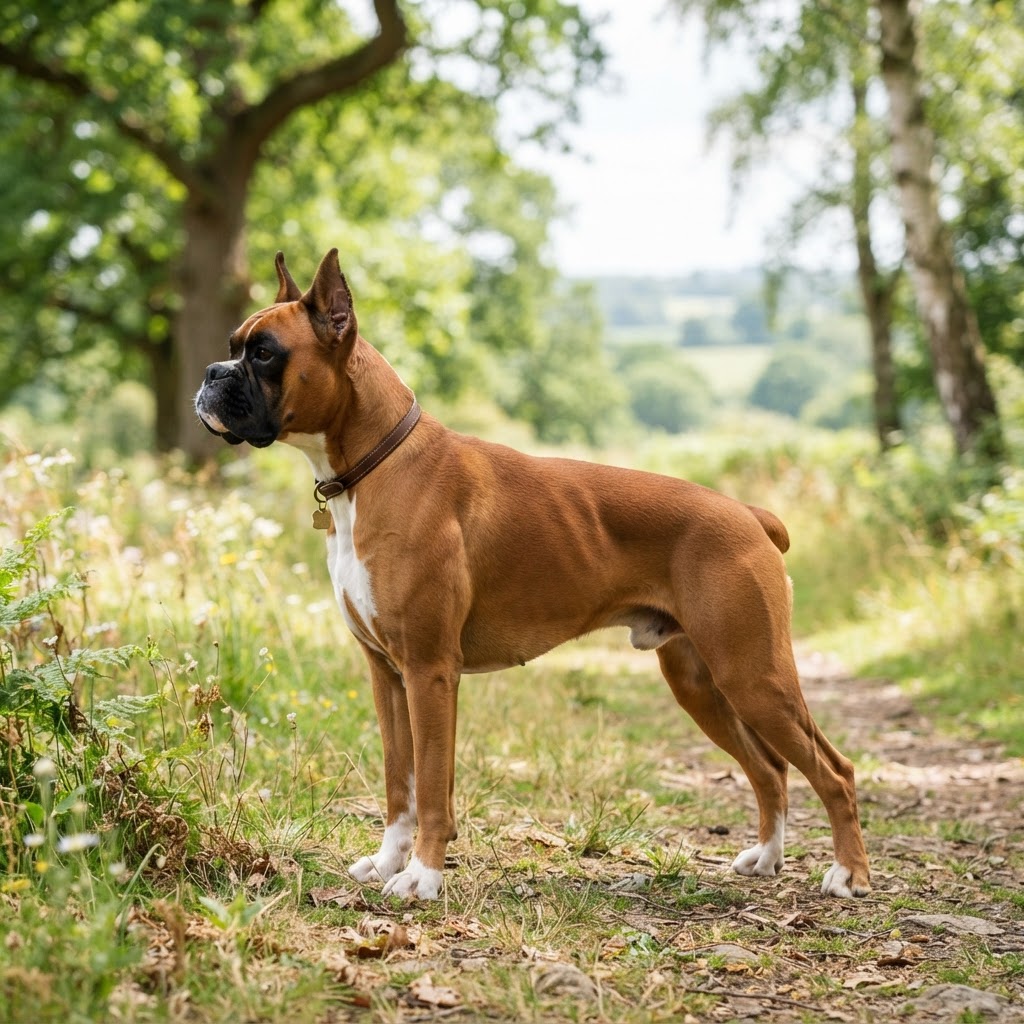
Boxer
Male: 30-32 kg; Female: 25-27 kg
Male: 57-63 cm; Female: 53-59 cm
10-12 years
Germany
About the Boxer
The Boxer is a medium-to-large, square-built dog of noble appearance and boundless energy. Developed in 19th-century Germany from the now-extinct Bullenbeisser and the English Bulldog, the breed was refined to be a versatile working dog. They are famously known as the 'Peter Pan' of the canine world because they remain puppy-like and playful well into their senior years, making them exceptional companions for active families. Physically, the Boxer is a masterpiece of functional musculature, possessing a short back, strong limbs, and a powerful, blunt muzzle designed for gripping. Their expressive faces, characterized by dark, soulful eyes and a slightly undershot jaw, convey a range of emotions from deep intelligence to comical curiosity. As a member of the Working group, they are alert guardians who are naturally wary of strangers but intensely loyal and affectionate with their inner circle.
Breed Standard
Key characteristics from the breed standard
In the ring, a Boxer must exhibit a perfect balance of substance and elegance, moving with a ground-covering, rhythmic gait that shows power in the hindquarters and reach in the front. The head is the breed's most distinctive feature, requiring a correctly proportioned muzzle-to-skull ratio and a clean, dry neck. What truly elevates the Boxer is their 'arresting' presence—a combination of an alert, noble carriage and a spirited, steady temperament that suggests both a capable guardian and a joyful companion.
In Australia
In approximately 1948, the first Boxers were imported into Australia by Mr H. Wheatland of Tinarra Kennels, with the three initial entrants being Tirkane Tony, Tirkane Daybreak and Tirkane Jewel. According to the Boxer Association of Victoria, Panfield Zest arrived later through Mr H.E. Taylor.
Bred For
Big-game hunting (wild boar, bear, and deer), and later as a butcher's assistant and guardian.
Temperament
Devoted, fearless, energetic, playful, and highly intelligent with a distinctively joyful 'Peter Pan' personality.
Health Conditions Reported in the Breed
(), (), Mast Cell Tumours, Lymphoma, , (), and Histiocytic Ulcerative Colitis.
Grooming Needs
Minimal; weekly brushing to remove dead hair and regular cleaning of facial folds and ears.
Living Suitability
Requires a medium-to-large yard; not ideally suited for small apartments unless very high exercise needs are met daily.
Good with Kids
Excellent; very patient and protective of children, though their exuberance may be too much for toddlers.
Good with Other Pets
Generally good if socialised early, though some may exhibit same-sex aggression or high prey drive toward small animals.
Trainability
Highly intelligent but can be headstrong; responds best to positive reinforcement and varied training sessions.
Coat & Colours
Short, glossy, and smooth, lying tight to the body.. Fawn or Brindle, often with white markings (flashy).
Exercise needs vary by age, fitness, health, weather and individual temperament. Consult your veterinarian for an exercise plan appropriate for your dog.
Things to Consider
Every breed has its quirks — here's what to know
Boxers are more likely to experience heart conditions like ARVC and SAS—this doesn't mean every Boxer will, but regular veterinary cardiac screening is vital. They are also more prone to certain cancers, so owners should be vigilant about new lumps or bumps. Being a deep-chested breed, they have a higher risk of Bloat (GDV); feeding smaller meals and avoiding vigorous exercise immediately after eating is a sensible precaution. Boxers can be quite flatulent and may drool, especially around mealtime—a small trade-off for their comical antics. They are also sensitive to extreme temperatures due to their short muzzles and coats, so they should be kept indoors during hot Australian summer days. Many Boxers also develop skin allergies or sensitive stomachs on standard commercial kibble, often thriving on a fresh, single-protein raw diet. While they are incredibly loyal, their high energy and desire for companionship mean they can develop separation anxiety if left alone for long periods without mental stimulation.
Feeding Guide for Your Boxer
Healthy Weight
25-32 kg
Daily Feeding Amount (general starting estimate)
600-960 grams
Adult Boxers should be fed approximately 2-3% of their ideal body weight daily in fresh, high-quality raw food. Some owners use smaller divided meals and avoid strenuous activity immediately around feeding. These steps cannot guarantee prevention of gastric dilatation-volvulus. Seek urgent veterinary care if bloat is suspected.
Feeding quantities are general starting estimates only. Individual needs vary with body condition, weight trends, age, health and activity. Ingredient percentages alone do not guarantee complete and balanced nutrition — consult a veterinarian for individualised dietary guidance.
Ingredient percentages alone do not guarantee complete and balanced nutrition. Seek veterinary or qualified canine nutrition guidance for individualised dietary advice. Raw feeding, specific proteins or fresh foods should not be presented as preventing, treating or managing breed health conditions without veterinary diagnosis and supervision.
Majestik's Recommended Feeding Approach
Breed Diet Notes
A high-protein, moderate-fat diet rich in Omega-3 fatty acids to support heart health and skin integrity. Low-glycemic ingredients are preferred due to cancer predispositions.
A rotation of lean proteins such as Kangaroo and Beef from Majestik Pet Food, supplemented with Sardines or Salmon for heart-supporting Omega-3s. Include pureed leafy greens and antioxidant-rich berries to support immune health and combat cancer predispositions. Avoid high-filler diets that can trigger flatulence or sensitive digestion.
These are general breed-level notes only. The appropriate food and serving amount depend on the individual dog's age, health, body condition, activity and tolerance.
Majestik Recommendation
Majestik BARF meals follow our practical 70/10/10/10 approach: approximately 70% quality meat and protein ingredients, 10% edible bone, 10% vegetables and 10% offal. This gives customers a convenient fresh-food option without needing to source and portion every ingredient themselves.
Our Beef, Lamb and Roo BARF meals provide convenient fresh-food options, with suitable proteins chosen or rotated according to the individual dog.
Suitable for different needs
- Healthy adult: Majestik adult Beef, Lamb or Roo BARF meal.
- Puppy: Majestik Premium Puppy.
- Senior: Majestik Senior Blend.
- Working or highly active dog: Suitable Majestik adult meal with quantity adjusted to workload and body condition.
- Protein trial: One Majestik protein at a time.
Recommended Majestik BARF Meals


This is a practical starting recommendation for healthy dogs. Individual needs vary with age, health, body condition and activity.
Boxer Feeding Calculator
Personalised raw and cooked feeding recommendations based on your dog's profile
Ideal — Ribs palpable without excess fat. Visible waist. Abdominal tuck present.
Have a question about your Boxer? Dog Health AI
Why Majestik?
Fresh, raw pet food made with integrity in South Australia
Australian Made
Made in Two Wells, South Australia
Freshly Prepared
Real meat, organs, bone & wholefood ingredients
No Fillers
No cheap fillers or artificial preservatives
Family Owned
Locally owned and operated
Local Delivery
Delivery across Adelaide & selected areas
Secure Checkout
Secure payment via Shopify checkout
Subscribe & Save on Boxer Meals
Get your Boxer's fresh and raw meals delivered every two or four weeks. Small subscriptions are combined into a four-week box. Pause, skip or cancel anytime.
Breed Records & Facts
Oldest Recorded
18 years (Maccabee, UK - though individual Australian records are not centrally tracked by name)
Average Litter Size
6-8 puppies
Boxer Owner Feedback
Real experiences and tips from Boxer owners
No reviews yet
Be the first to share your experience with this breed
Other Large Breeds
References & Sources
Breed information verified against recognised breed authorities and veterinary evidence.