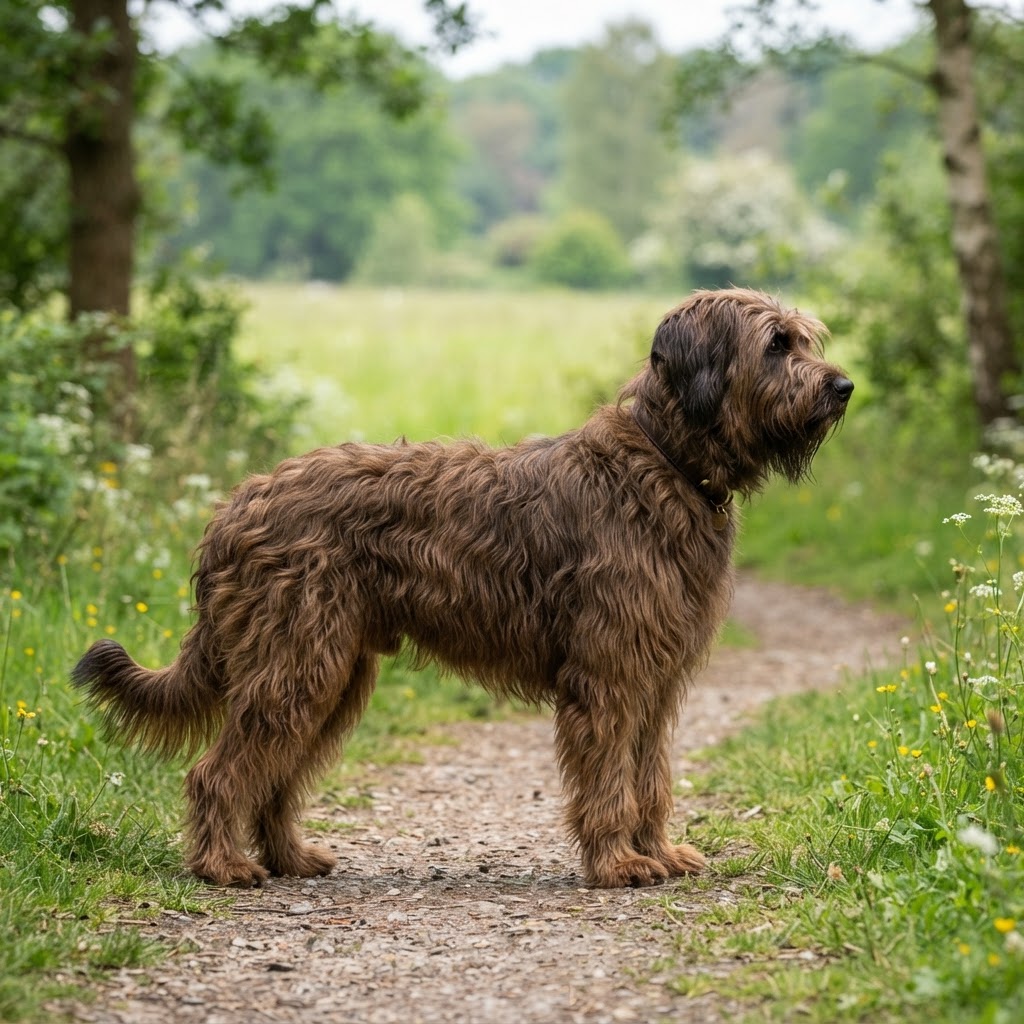
Briard
Male: 30-40 kg, Female: 23-34 kg
58-69 cm (Males: 62-69 cm; Females: 58-65 cm)
10-12 years
France
About the Briard
The Briard, or Berger de Brie, is an ancient French herding breed known as a 'heart wrapped in fur.' Characterised by its impressive long coat and distinctive 'crochet' tail, this breed combines the power of a guardian with the agility of a shepherd. They are famous for their double dewclaws on the hind legs, a historical requirement for traversing rugged terrain while managing large flocks. In a home environment, the Briard is deeply devoted to its family, often acting as a watchful protector. They are highly intelligent and require consistent, positive reinforcement training and significant mental engagement. While they are affectionate with their 'inner circle,' they can be reserved with strangers, making early socialisation vital for a well-adjusted adult dog.
Breed Standard
Key characteristics from the breed standard
In the show ring, the Briard is a picture of rustic power and supple elegance. The breed standard demands a powerful, well-boned frame covered in a 'goat-like' coat that must never be woolly. Their movement is a hallmark of the breed—described as 'quicksilver'—covering ground with an effortless, gliding gait that suggests they are barely touching the floor. The distinctive double dewclaws on the hind legs are a non-negotiable trait of correct conformation.
In Australia
The Briard was introduced to Australia in 1968. Following its introduction in 1968, further Briards were imported into Australia during the early 1970s. The first breed-specific club, the Briard Club of NSW, was established in 1974.
Bred For
Flock herding and guarding sheep against predators such as wolves.
Temperament
Faithful, intelligent, protective, and courageous with a spirited nature.
Health Conditions Reported in the Breed
, Congenital Stationary Night Blindness (CSNB), (), , and .
Grooming Needs
High; requires deep brushing several times a week to prevent matting of the double coat and regular ear cleaning.
Living Suitability
Suited to homes with large, securely fenced yards or acreage.
Good with Kids
Generally good with children in their own family, though their herding instinct may lead them to 'nip' at heels during play; best for families with older children.
Good with Other Pets
Can be dominant with other dogs of the same sex; usually fine with household pets if raised with them, though high prey drive can exist.
Trainability
Highly intelligent and capable but possesses an independent streak; requires a firm, fair, and consistent leader.
Coat & Colours
Long, slightly wavy, dry and coarse 'goat-like' texture with a fine, dense undercoat.. Black, fawn, and grey.
Exercise needs vary by age, fitness, health, weather and individual temperament. Consult your veterinarian for an exercise plan appropriate for your dog.
Things to Consider
Every breed has its quirks — here's what to know
Prospective owners should be aware that Briards are predisposed to Gastric Dilatation-Volvulus (Bloat), a life-threatening condition where the stomach twists. Using slow-feeders and avoiding exercise immediately after meals can help manage this risk. They are also prone to Congenital Stationary Night Blindness (CSNB); ensuring your breeder screens for this DNA marker is essential. Their magnificent coat is a significant commitment—without thorough brushing down to the skin, they will develop painful mats, especially behind the ears and in the 'armpits.' As a herding breed, they may attempt to herd moving objects (bikes, cars, children), which requires redirecting through training. Some Briards can have sensitive digestive systems; they often thrive on a grain-free, fresh-food diet as standard commercial fillers may cause flatulence or soft stools. While they are naturally protective, early and ongoing socialisation is required to ensure their guarding instinct remains discerning and manageable.
Feeding Guide for Your Briard
Healthy Weight
23-40 kg
Daily Feeding Amount (general starting estimate)
700-1000 grams
For an adult Briard, a fresh or raw diet should be calculated at approximately 2-3% of their ideal body weight daily. Some owners use smaller divided meals and avoid strenuous activity immediately around feeding. These steps cannot guarantee prevention of gastric dilatation-volvulus. Seek urgent veterinary care if bloat is suspected. Focus on lean proteins like Majestik Kangaroo or Beef, supplemented with calcium-rich bone and organ meat.
Feeding quantities are general starting estimates only. Individual needs vary with body condition, weight trends, age, health and activity. Ingredient percentages alone do not guarantee complete and balanced nutrition — consult a veterinarian for individualised dietary guidance.
Ingredient percentages alone do not guarantee complete and balanced nutrition. Seek veterinary or qualified canine nutrition guidance for individualised dietary advice. Raw feeding, specific proteins or fresh foods should not be presented as preventing, treating or managing breed health conditions without veterinary diagnosis and supervision.
Majestik's Recommended Feeding Approach
Breed Diet Notes
A high-quality, protein-rich diet formulated for large working breeds, ideally focusing on fresh, whole-food ingredients to support joint health and digestive efficiency.
Given their susceptibility to hip issues, the inclusion of Green Lipped Mussel or fish oil for Omega-3 fatty acids is highly recommended. Because they are deep-chested, avoid feeding large volumes of high-carbohydrate fillers that can ferment and contribute to gas.
These are general breed-level notes only. The appropriate food and serving amount depend on the individual dog's age, health, body condition, activity and tolerance.
Majestik Recommendation
Majestik BARF meals follow our practical 70/10/10/10 approach: approximately 70% quality meat and protein ingredients, 10% edible bone, 10% vegetables and 10% offal. This gives customers a convenient fresh-food option without needing to source and portion every ingredient themselves.
Our Beef, Lamb and Roo BARF meals provide convenient fresh-food options, with suitable proteins chosen or rotated according to the individual dog.
Suitable for different needs
- Healthy adult: Majestik adult Beef, Lamb or Roo BARF meal.
- Puppy: Majestik Premium Puppy.
- Senior: Majestik Senior Blend.
- Working or highly active dog: Suitable Majestik adult meal with quantity adjusted to workload and body condition.
- Protein trial: One Majestik protein at a time.
Recommended Majestik BARF Meals


This is a practical starting recommendation for healthy dogs. Individual needs vary with age, health, body condition and activity.
Briard Feeding Calculator
Personalised raw and cooked feeding recommendations based on your dog's profile
Ideal — Ribs palpable without excess fat. Visible waist. Abdominal tuck present.
Have a question about your Briard? Dog Health AI
Why Majestik?
Fresh, raw pet food made with integrity in South Australia
Australian Made
Made in Two Wells, South Australia
Freshly Prepared
Real meat, organs, bone & wholefood ingredients
No Fillers
No cheap fillers or artificial preservatives
Family Owned
Locally owned and operated
Local Delivery
Delivery across Adelaide & selected areas
Secure Checkout
Secure payment via Shopify checkout
Subscribe & Save on Briard Meals
Get your Briard's fresh and raw meals delivered every two or four weeks. Small subscriptions are combined into a four-week box. Pause, skip or cancel anytime.
Breed Records & Facts
Average Litter Size
8-10 puppies
Briard Owner Feedback
Real experiences and tips from Briard owners
No reviews yet
Be the first to share your experience with this breed
Other Large Breeds
References & Sources
Breed information verified against recognised breed authorities and veterinary evidence.