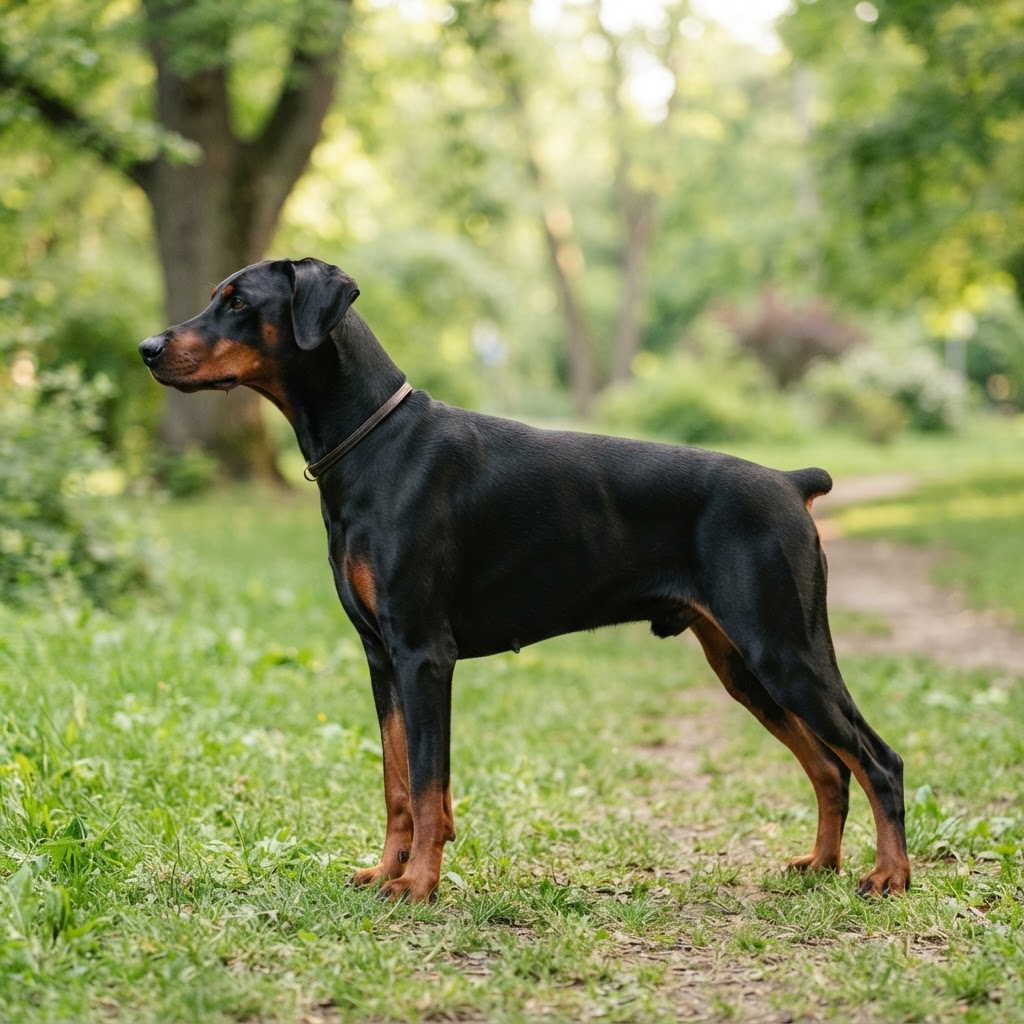
Dobermann
Male: 40-45 kg, Female: 32-35 kg
Male: 68-72 cm, Female: 63-68 cm at the shoulder.
10-12 years
Germany
About the Dobermann
The Dobermann is a medium-large dog of elegant build, combining great strength with speed and endurance. Originating in Germany in the late 19th century, the breed was developed by Louis Dobermann to serve as a formidable protector and companion. Its silhouette is compact and muscular, conveying an impression of nobility and alertness. Known as the 'tax collector's dog,' the breed has transitioned from a fierce guardian to a devoted family member that thrives on human interaction. Characteristically energetic and watchful, the Dobermann is renowned for its high trainability and versatile working abilities. They are deeply devoted to their families and possess an innate desire to protect. While they can be wary of strangers, a well-bred Dobermann is stable and discerning. This breed is not suited to kennel life; they are 'Velcro dogs' who require inclusion in the household and consistent, firm, yet fair leadership to channel their intensity effectively.
Breed Standard
Key characteristics from the breed standard
In the show ring, the Dobermann is the epitome of power packaged in elegance. The breed standard demands a square silhouette where the height at the withers equals the length of the body, creating a balanced, athletic frame. The movement is distinguished by a reach and drive that appears effortless, covering ground with a balanced, rhythmic gait that never sacrifices stability for speed. A correctly structured Dobermann possesses a clean-cut head, a long, arched neck, and a hard, glistening coat that accentuates every muscle ripple.
In Australia
The Dobermann was first introduced to Australia in 1952 following the lifting of a long-standing ban on the breed's importation, as noted by the Dobermann Club of NSW. The first recorded Dobermann in Australia was a female named 'Konigsee Schone Hexe', who was imported by Mr. and Mrs. J. S. P. Richardson.
Bred For
Personal protection, guard work, and police assistance.
Temperament
Alert, loyal, energetic, determined, and highly intelligent.
Health Conditions Reported in the Breed
(), Von Willebrand’s Disease (), , Cervical Vertebral Instability (), , and ().
Exercise Needs
High.
Grooming Needs
Low. The short coat requires minimal brushing, typically once a week to remove loose hair and maintain skin health.
Living Suitability
Requires a house with a securely fenced yard. Not ideal for apartment living due to high energy and space requirements. They are indoor dogs that need to live within the family unit.
Good with Kids
Generally good with children in their own family, especially when raised together. Supervision is recommended due to their size and energy.
Good with Other Pets
Can be dominant with other dogs of the same sex. Usually good with other household pets if socialised early, though their prey drive may be triggered by smaller animals.
Trainability
Highly intelligent and eager to please, ranking among the top breeds for obedience and working intelligence. Requires consistent, positive-reinforcement training.
Coat & Colours
Short, hard, and thick.. Black and tan, Brown and tan (Red), Blue and tan, or Fawn (Isabella) and tan.
Exercise needs vary by age, fitness, health, weather and individual temperament. Consult your veterinarian for an exercise plan appropriate for your dog.
Things to Consider
Every breed has its quirks — here's what to know
Dobermanns are more likely to experience separation anxiety; they are affectionately known as 'Velcro dogs' and thrive on constant human companionship, so they may struggle if left alone for long periods. They are predisposed to Gastric Dilation-Volvulus (Bloat) due to their deep-chested conformation—owners should avoid vigorous exercise immediately after meals and consider feeding smaller, frequent portions. The breed is also prone to Dilated Cardiomyopathy (DCM), a serious heart condition that requires regular veterinary screening. Their single coat makes them highly sensitive to cold weather; a coat or jumper is often necessary during Australian winters. While they are moderate shedders, their short, stiff hairs can weave into fabrics and be difficult to remove. Additionally, Dobermanns are more likely to develop Von Willebrand’s Disease (vWD), a blood clotting disorder, which should be tested for before any surgical procedures. With their high intelligence comes a need for mental work—without it, they can become destructive or vocal out of boredom. These challenges are manageable with proactive veterinary care and a committed owner who can provide the structure and affection this noble breed craves.
Feeding Guide for Your Dobermann
Healthy Weight
Male: 40-45 kg, Female: 32-35 kg
Daily Feeding Amount (general starting estimate)
800g to 1200g per day, adjusted based on activity level and metabolism.
For an adult Dobermann, feeding a fresh or raw diet at 2-3% of their ideal body weight is recommended. Some owners use smaller divided meals and avoid strenuous activity immediately around feeding. These steps cannot guarantee prevention of gastric dilatation-volvulus. Seek urgent veterinary care if bloat is suspected. For a 40kg male, this equates to approximately 800g to 1200g of fresh food per day.
Feeding quantities are general starting estimates only. Individual needs vary with body condition, weight trends, age, health and activity. Ingredient percentages alone do not guarantee complete and balanced nutrition — consult a veterinarian for individualised dietary guidance.
Ingredient percentages alone do not guarantee complete and balanced nutrition. Seek veterinary or qualified canine nutrition guidance for individualised dietary advice. Raw feeding, specific proteins or fresh foods should not be presented as preventing, treating or managing breed health conditions without veterinary diagnosis and supervision.
Majestik's Recommended Feeding Approach
Breed Diet Notes
A high-protein, nutrient-dense diet with controlled fat levels. Fresh, raw diets are often preferred to maintain lean muscle mass and support cardiac health through natural taurine and amino acids.
A balanced raw diet for a Dobermann should focus on lean, high-quality proteins to support their muscular frame without excess weight gain. Majestik's Kangaroo and Beef options are excellent primary protein sources. Inclusion of leafy greens and oily fish (like sardines) provides essential omega-3 fatty acids for skin and coat health. Given the breed's predisposition to DCM, ensure the diet is rich in natural taurine found in heart meat and red meats.
These are general breed-level notes only. The appropriate food and serving amount depend on the individual dog's age, health, body condition, activity and tolerance.
Majestik Recommendation
Majestik BARF meals follow our practical 70/10/10/10 approach: approximately 70% quality meat and protein ingredients, 10% edible bone, 10% vegetables and 10% offal. This gives customers a convenient fresh-food option without needing to source and portion every ingredient themselves.
Our Beef, Lamb and Roo BARF meals provide convenient fresh-food options, with suitable proteins chosen or rotated according to the individual dog.
Suitable for different needs
- Healthy adult: Majestik adult Beef, Lamb or Roo BARF meal.
- Puppy: Majestik Premium Puppy.
- Senior: Majestik Senior Blend.
- Working or highly active dog: Suitable Majestik adult meal with quantity adjusted to workload and body condition.
- Protein trial: One Majestik protein at a time.
Recommended Majestik BARF Meals


This is a practical starting recommendation for healthy dogs. Individual needs vary with age, health, body condition and activity.
Dobermann Feeding Calculator
Personalised raw and cooked feeding recommendations based on your dog's profile
Ideal — Ribs palpable without excess fat. Visible waist. Abdominal tuck present.
Have a question about your Dobermann? Dog Health AI
Why Majestik?
Fresh, raw pet food made with integrity in South Australia
Australian Made
Made in Two Wells, South Australia
Freshly Prepared
Real meat, organs, bone & wholefood ingredients
No Fillers
No cheap fillers or artificial preservatives
Family Owned
Locally owned and operated
Local Delivery
Delivery across Adelaide & selected areas
Secure Checkout
Secure payment via Shopify checkout
Subscribe & Save on Dobermann Meals
Get your Dobermann's fresh and raw meals delivered every two or four weeks. Small subscriptions are combined into a four-week box. Pause, skip or cancel anytime.
Breed Records & Facts
Average Litter Size
6-8 puppies
Dobermann Owner Feedback
Real experiences and tips from Dobermann owners
No reviews yet
Be the first to share your experience with this breed
Other Large Breeds
References & Sources
Breed information verified against recognised breed authorities and veterinary evidence.