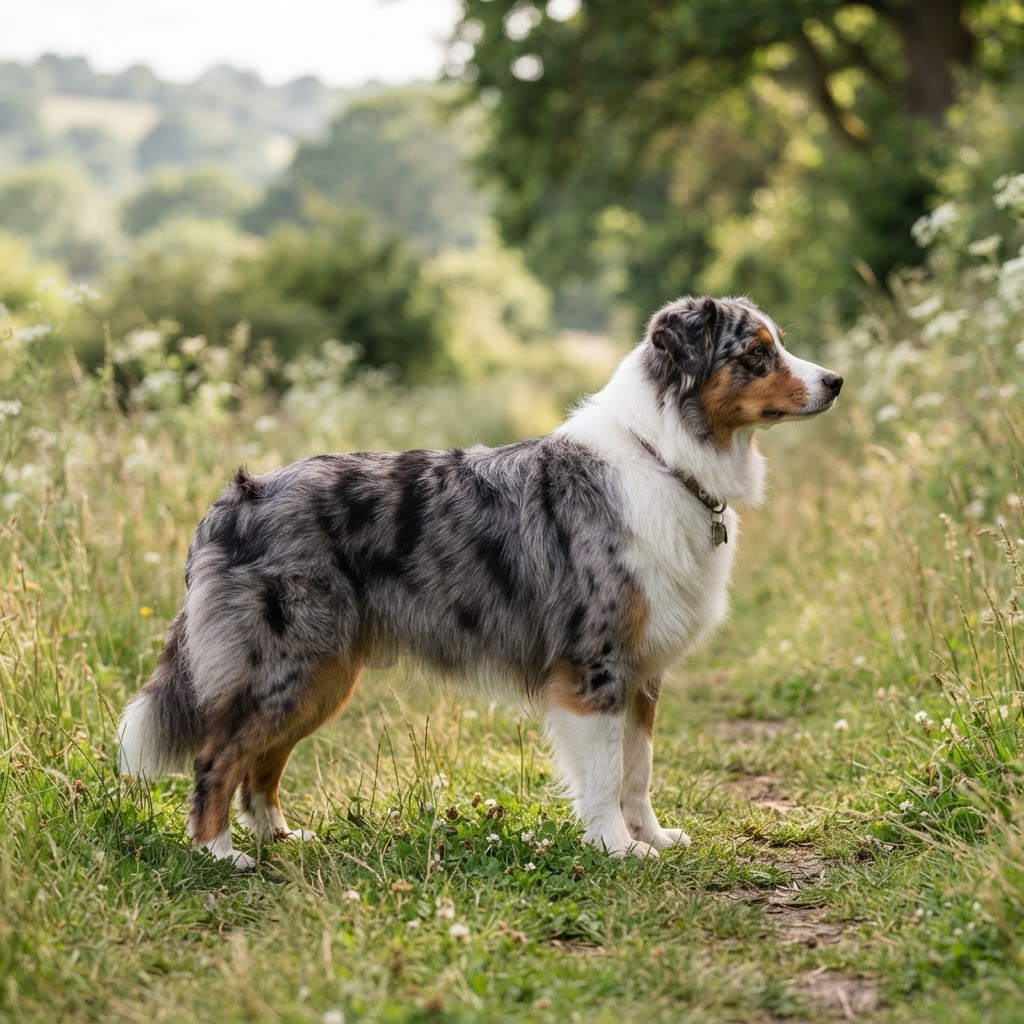
Australian Shepherd
Male: 23-30 kg, Female: 18-25 kg
Males: 51-58 cm, Females: 46-53 cm at the shoulder.
12-15 years
United States of America
About the Australian Shepherd
The Australian Shepherd, despite its name, was developed in the United States to handle the demanding work of Western ranches. They are exceptionally agile and intelligent dogs, known for their 'piercing' gaze and remarkable ability to control livestock with minimal direction. Beyond the ranch, they have become one of the most successful competitors in dog sports like agility, obedience, and flyball due to their intense desire to work alongside their human partners. Physically, the 'Aussie' is a well-balanced dog of medium size and bone, slightly longer than tall. Their most striking feature is often their coat, which comes in a beautiful array of merle patterns and solid colors, often paired with bright, expressive eyes. They are famous for being 'Velcro dogs,' forming incredibly tight bonds with their families and often following their owners from room to room, eager to participate in any activity.
Despite its name, the Australian Shepherd was developed as a breed in the United States, not in Australia. It is not a true-blue Australian-developed breed.
Breed Standard
Key characteristics from the breed standard
In the show ring, the Australian Shepherd must display a 'work-ready' appearance—balanced, athletic, and lithe without being coarse or weedy. Their movement is a hallmark of the breed; it should be smooth, free, and easy, showing great agility with a ground-covering stride that suggests they could work all day. Their coat, while beautiful, must never be so long as to hinder their movement, emphasizing function over pure fashion.
In Australia
The Australian Shepherd was first imported into Australia in 1990 according to the Australian Shepherd Club of Victoria. Following this, the first litter of Australian Shepherds was born in Australia in 1991, and the breed was subsequently introduced as a versatile working and companion dog by Dogs Australia. By 1994, the breed gained official recognition by the Australian National Kennel Council (ANKC).
Bred For
Versatile ranch and stock dog, primarily used for herding sheep and cattle in the American West.
Temperament
Intelligent, energetic, loyal, and highly focused with a strong herding instinct.
Health Conditions Reported in the Breed
Hereditary , Collie Eye Anomaly (CEA), Hip and , and the MDR1 (Multi-Drug Resistance) gene mutation which causes sensitivity to certain medications.
Exercise Needs
Very High.
Grooming Needs
Moderate. Requires weekly brushing to manage the double coat, increasing to daily during seasonal shedding periods (blowing coat).
Living Suitability
Not suited for apartment living. They require a home with a large, secure yard or acreage where they can run and work. They thrive in environments where they have constant human interaction.
Good with Kids
Generally very good with children, though their herding instinct may lead them to 'nip' at heels during play; supervision and training are essential.
Good with Other Pets
Usually good with other dogs and can live with cats if raised together, though they may attempt to herd other household pets.
Trainability
Highly intelligent and eager to please, making them exceptionally easy to train for complex tasks, though they require a confident handler to provide consistent direction.
Coat & Colours
Medium length, straight to slightly wavy, weather-resistant double coat with a moderate mane and frill.. Blue merle, black, red merle, red; all with or without white markings and/or tan (copper) points.
Exercise needs vary by age, fitness, health, weather and individual temperament. Consult your veterinarian for an exercise plan appropriate for your dog.
Things to Consider
Every breed has its quirks — here's what to know
Australian Shepherds are high-octane dogs that require significant time and engagement; they are more likely to develop boredom-based behaviors like digging or excessive barking if their mental needs aren't met. They are known 'shedders,' meaning you will find hair throughout your home, especially during their twice-yearly 'coat blow' which requires daily brushing. Because of their 'Velcro' nature, they can be predisposed to separation anxiety if not taught to spend time alone from a young age. Prospective owners must be aware of the MDR1 gene mutation, which is more likely to occur in this breed; this makes them sensitive to certain medications like ivermectin, so genetic testing is a must to ensure safe veterinary care. While they are incredibly loyal, their herding drive can lead to chasing cars or nipping at the heels of running children—this is a natural instinct that needs to be channeled into sports or games. They can also be reserved with strangers, so early socialization is key to ensuring they are confident and well-adjusted. These quirks are simply signs of their brilliance and devotion, and in the right active home, they are incomparable companions.
Feeding Guide for Your Australian Shepherd
Healthy Weight
18-30 kg
Daily Feeding Amount (general starting estimate)
450-900 grams of fresh/raw food daily, depending on the individual dog's weight and activity level.
For an adult Australian Shepherd, feeding should be based on 2-3% of their ideal body weight daily. For an average 25kg dog, this equates to 500g to 750g of fresh food per day, divided into two meals. Highly active working Aussies may require up to 4% of their body weight to maintain condition.
Feeding quantities are general starting estimates only. Individual needs vary with body condition, weight trends, age, health and activity. Ingredient percentages alone do not guarantee complete and balanced nutrition — consult a veterinarian for individualised dietary guidance.
Ingredient percentages alone do not guarantee complete and balanced nutrition. Seek veterinary or qualified canine nutrition guidance for individualised dietary advice. Raw feeding, specific proteins or fresh foods should not be presented as preventing, treating or managing breed health conditions without veterinary diagnosis and supervision.
Majestik's Recommended Feeding Approach
Breed Diet Notes
A high-quality, high-protein diet is essential to support their high energy levels. A fresh, raw-food diet rich in lean proteins and essential fatty acids is often ideal for maintaining muscle condition and coat health.
A balanced raw diet for an Aussie should focus on high-quality proteins like Majestik's lean Beef or Kangaroo to fuel their athletic bodies. Adding fresh seasonal vegetables and a source of Omega-3, like fish or hemp seed oil, supports their dense double coat and cognitive function. Given their predisposition to joint issues, inclusion of natural glucosamine sources like chicken feet or green-lipped mussel is highly recommended.
These are general breed-level notes only. The appropriate food and serving amount depend on the individual dog's age, health, body condition, activity and tolerance.
Majestik Recommendation
Majestik BARF meals follow our practical 70/10/10/10 approach: approximately 70% quality meat and protein ingredients, 10% edible bone, 10% vegetables and 10% offal. This gives customers a convenient fresh-food option without needing to source and portion every ingredient themselves.
Our Beef, Lamb and Roo BARF meals provide convenient fresh-food options, with suitable proteins chosen or rotated according to the individual dog.
Suitable for different needs
- Healthy adult: Majestik adult Beef, Lamb or Roo BARF meal.
- Puppy: Majestik Premium Puppy.
- Senior: Majestik Senior Blend.
- Working or highly active dog: Suitable Majestik adult meal with quantity adjusted to workload and body condition.
- Protein trial: One Majestik protein at a time.
Recommended Majestik BARF Meals


This is a practical starting recommendation for healthy dogs. Individual needs vary with age, health, body condition and activity.
Australian Shepherd Feeding Calculator
Personalised raw and cooked feeding recommendations based on your dog's profile
Ideal — Ribs palpable without excess fat. Visible waist. Abdominal tuck present.
Have a question about your Australian Shepherd? Dog Health AI
Why Majestik?
Fresh, raw pet food made with integrity in South Australia
Australian Made
Made in Two Wells, South Australia
Freshly Prepared
Real meat, organs, bone & wholefood ingredients
No Fillers
No cheap fillers or artificial preservatives
Family Owned
Locally owned and operated
Local Delivery
Delivery across Adelaide & selected areas
Secure Checkout
Secure payment via Shopify checkout
Subscribe & Save on Australian Shepherd Meals
Get your Australian Shepherd's fresh and raw meals delivered every two or four weeks. Small subscriptions are combined into a four-week box. Pause, skip or cancel anytime.
Breed Records & Facts
Average Litter Size
6-9 puppies
Australian Shepherd Owner Feedback
Real experiences and tips from Australian Shepherd owners
No reviews yet
Be the first to share your experience with this breed
Other Medium Breeds
References & Sources
Breed information verified against recognised breed authorities and veterinary evidence.