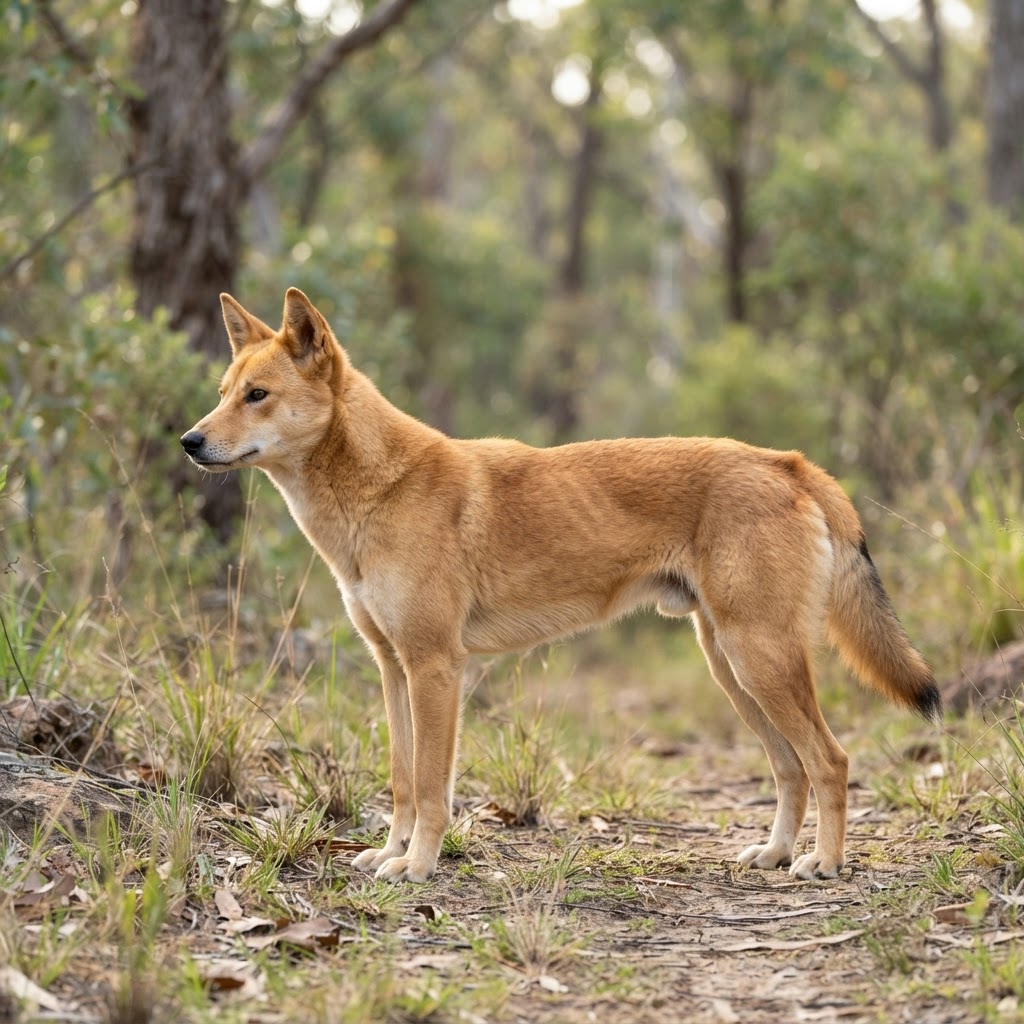
Dingo
Male: 12-22 kg, Female: 10-18 kg
44-60 cm at the shoulder
10-15 years in the wild; up to 18-20 years in managed care.
Australia (via South East Asia)
About the Dingo
The Dingo is Australia's native canid, a primitive dog that has remained largely unchanged for millennia. Unlike domestic dogs, Dingoes are a landrace shaped by the harsh Australian environment rather than human selection. They are characterized by their athletic build, wedge-shaped head, and distinctive erect ears. Their physiology is unique among canids, featuring flexible joints that allow them to climb and rotate their wrists similarly to cats. In a domestic or sanctuary setting, Dingoes are not 'pets' in the traditional sense. They are highly independent thinkers with complex social structures and a cautious nature toward strangers. Owning or caring for a Dingo in Australia is subject to strict state-based legislation, often requiring specific permits and high-security enclosures. They are remarkably clean animals with little 'doggy' odor, but their high intelligence and primitive instincts require an experienced handler who understands wild canid behavior.
Breed Standard
Key characteristics from the breed standard
While not a standard ANKC exhibition breed, the Dingo displays a structural perfection honed by survival. Their movement is fluid, efficient, and exceptionally quiet, showing a 'tracking' gait where hind paws land in the prints of the front paws. The structure is one of absolute balance: a straight topline, deep chest for lung capacity, and incredibly strong, agile limbs.
In Australia
Archaeological evidence confirms the Dingo's presence in Australia for at least 3,500 to 4,000 years, likely arriving with seafarers from South East Asia.
Bred For
Natural landrace/Apex predator; not selectively bred by humans.
Temperament
Independent, highly intelligent, cautious, social with their own pack, and possesses a strong predatory instinct.
Health Conditions Reported in the Breed
Generally hardy due to natural selection; however, they are susceptible to common canine diseases including Heartworm, Hookworm, Distemper, Parvovirus, and rcoptic Mange.
Exercise Needs
Very High; requires significant mental stimulation and physical activity to prevent boredom and destructive behaviors.
Grooming Needs
Minimal; they have a self-cleaning coat that requires only occasional brushing, though they undergo a heavy seasonal moult.
Living Suitability
can adapt to apartment living living or standard suburban backyards. Requires large, high-security acreage with fencing at least 2.4 meters high and dig-proof footings.
Good with Kids
Generally not recommended for households with young children due to their primitive instincts and cautious temperament.
Good with Other Pets
High prey drive makes them unsuitable for homes with small animals or cats; can be socialized with other large dogs but typically prefer their own kind.
Trainability
Highly intelligent but independent; they do not possess the 'eagerness to please' found in domestic breeds and require motivation-based training.
Coat & Colours
Double coat with a soft undercoat and a coarse, weather-resistant outer coat.. Ginger (ranging from sandy to red), black and tan, and occasionally white.
Exercise needs vary by age, fitness, health, weather and individual temperament. Consult your veterinarian for an exercise plan appropriate for your dog.
Things to Consider
Every breed has its quirks — here's what to know
Dingoes are legendary escape artists; they can climb, dig, and jump with surprising agility, meaning standard fencing is rarely sufficient. Prospective owners must be aware that Dingoes are more likely to exhibit high prey drive—this is a natural instinct and means they cannot be trusted off-lead or around small pets. They are also prone to seasonal 'howling' rather than barking, which is a beautiful but loud form of communication. From a health perspective, they can be susceptible to dietary sensitivities if fed highly processed commercial foods; many thrive much better on a Majestik fresh, raw diet that avoids grains and fillers. While generally very healthy, they are more likely to contract heartworm and other parasites in Australian conditions, so rigorous preventative care is essential. Their independent nature means they may not always seek affection on your terms, but their loyalty to their 'pack' is profound once earned.
Feeding Guide for Your Dingo
Healthy Weight
13-18 kg
Daily Feeding Amount (general starting estimate)
325-540 grams
For an adult Dingo, a fresh or raw diet should focus on high-quality animal proteins and moderate fats. Based on a healthy adult weight of 15 kg, we recommend approximately 375g to 450g of fresh food daily (2.5-3% of body weight). Portions should be adjusted based on activity levels and seasonal changes, as Dingoes are naturally adapted to lean periods.
Feeding quantities are general starting estimates only. Individual needs vary with body condition, weight trends, age, health and activity. Ingredient percentages alone do not guarantee complete and balanced nutrition — consult a veterinarian for individualised dietary guidance.
Ingredient percentages alone do not guarantee complete and balanced nutrition. Seek veterinary or qualified canine nutrition guidance for individualised dietary advice. Raw feeding, specific proteins or fresh foods should not be presented as preventing, treating or managing breed health conditions without veterinary diagnosis and supervision.
Majestik's Recommended Feeding Approach
Breed Diet Notes
A high-protein, evolutionary-appropriate raw diet mimicking their natural prey (macropods, small mammals, and reptiles) is considered optimal.
A Dingo's ideal diet focuses on lean, Australian-native proteins. Majestik Kangaroo is an excellent primary protein source, as it closely mirrors their natural prey. This should be supplemented with Majestik Beef or Lamb to provide variety. Dingoes can be sensitive to high-carbohydrate fillers found in commercial kibble, so a grain-free, fresh approach is vital for maintaining metabolic health and preventing obesity.
These are general breed-level notes only. The appropriate food and serving amount depend on the individual dog's age, health, body condition, activity and tolerance.
Majestik Recommendation
Majestik BARF meals follow our practical 70/10/10/10 approach: approximately 70% quality meat and protein ingredients, 10% edible bone, 10% vegetables and 10% offal. This gives customers a convenient fresh-food option without needing to source and portion every ingredient themselves.
Our Beef, Lamb and Roo BARF meals provide convenient fresh-food options, with suitable proteins chosen or rotated according to the individual dog.
Suitable for different needs
- Healthy adult: Majestik adult Beef, Lamb or Roo BARF meal.
- Puppy: Majestik Premium Puppy.
- Senior: Majestik Senior Blend.
- Working or highly active dog: Suitable Majestik adult meal with quantity adjusted to workload and body condition.
- Protein trial: One Majestik protein at a time.
Recommended Majestik BARF Meals


This is a practical starting recommendation for healthy dogs. Individual needs vary with age, health, body condition and activity.
Dingo Feeding Calculator
Personalised raw and cooked feeding recommendations based on your dog's profile
Ideal — Ribs palpable without excess fat. Visible waist. Abdominal tuck present.
Have a question about your Dingo? Dog Health AI
Why Majestik?
Fresh, raw pet food made with integrity in South Australia
Australian Made
Made in Two Wells, South Australia
Freshly Prepared
Real meat, organs, bone & wholefood ingredients
No Fillers
No cheap fillers or artificial preservatives
Family Owned
Locally owned and operated
Local Delivery
Delivery across Adelaide & selected areas
Secure Checkout
Secure payment via Shopify checkout
Subscribe & Save on Dingo Meals
Get your Dingo's fresh and raw meals delivered every two or four weeks. Small subscriptions are combined into a four-week box. Pause, skip or cancel anytime.
Breed Records & Facts
Average Litter Size
4-6 puppies
Dingo Owner Feedback
Real experiences and tips from Dingo owners
No reviews yet
Be the first to share your experience with this breed
Other Medium Breeds
References & Sources
Breed information verified against recognised breed authorities and veterinary evidence.