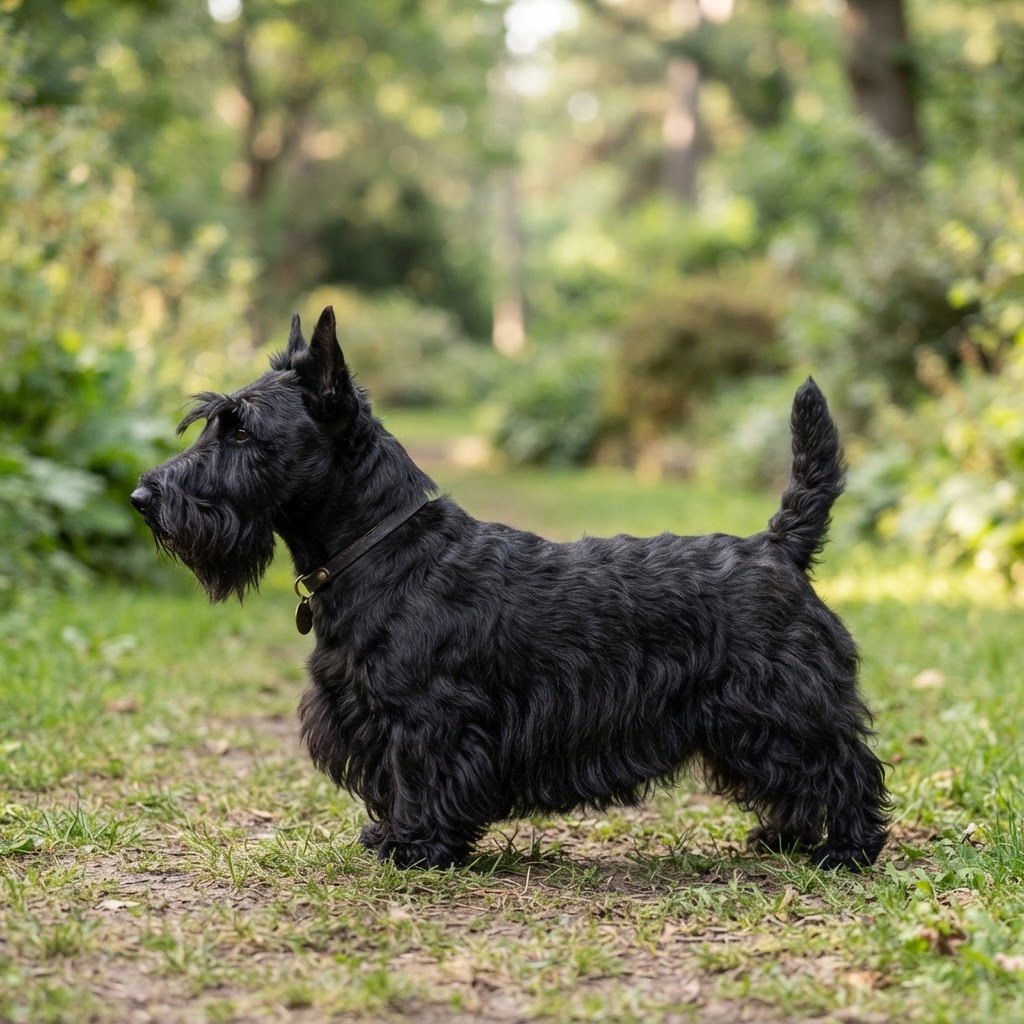
Scottish Terrier
Male: 8.5-10.5 kg, Female: 8.5-10.5 kg
25-28 cm at the shoulder
12-15 years
Scotland
About the Scottish Terrier
The Scottish Terrier is a sturdy, compact dog of great substance, instantly recognisable by its distinct silhouette, erect ears, and 'varminty' expression. Known as the 'Diehard' due to its legendary persistence and courage, this breed possesses a dignified and somewhat aloof personality toward strangers while remaining deeply loyal to its family. They are small in stature but possess the strength and spirit of a much larger dog, encapsulated in a low-slung, powerful frame that was originally designed to navigate the rugged terrain and burrows of the Scottish Highlands. In the home, the Scottie is an observant and independent companion. They are not 'lap dogs' in the traditional sense, preferring to sit nearby rather than on top of their owners, though they are intensely devoted. Their thick, weather-resistant double coat and keen intelligence make them adaptable, though their strong-willed nature requires a consistent and respectful approach to training. For Australian owners, they offer a robust personality suited to both suburban yards and more urban environments, provided their hunting instincts are appropriately channeled.
Breed Standard
Key characteristics from the breed standard
In the ring, the Scottish Terrier must exhibit an air of 'varminty' alertness and power in a small package. The head should be long with a slight stop, leading to a large black nose and keen, almond-shaped eyes. Their movement is unique—a smooth, hitch-free gait with great reach and drive, reflecting their digging and climbing heritage.
In Australia
The Scottish Terrier was first recorded in Australian dog shows during the 1880s, having been primarily imported from the UK. Recognized as a skilled vermin hunter, the breed established its presence in the country during this period.
Bred For
Vermin hunting, specifically foxes, badgers, and otters in the Scottish Highlands.
Temperament
Independent, dignified, spirited, and courageous; often described as the "Diehard" of the terrier world.
Health Conditions Reported in the Breed
Scottie Cramp (movement disorder), von Willebrand’s Disease (), Craniomandibular Osteopathy (CMO), Bladder Cancer (Transitional Cell Carcinoma), and s.
Exercise Needs
Moderate; daily walks of 30-45 minutes combined with interactive play satisfy their physical needs and mental curiosity.
Grooming Needs
High; requires regular brushing, professional clipping or hand-stripping every 6-8 weeks, and routine ear cleaning.
Living Suitability
Well-suited to apartment living or small backyards, provided they receive daily walks. They should be kept in securely fenced areas due to their hunting instincts.
Good with Kids
Generally good with older children who respect their boundaries; may be less tolerant of rough handling from toddlers.
Good with Other Pets
Can be territorial with other dogs and has a high prey drive toward small pets like cats or rabbits; early socialisation is essential.
Trainability
Highly intelligent but independent and occasionally stubborn; they respond best to positive reinforcement and variety in training routines.
Coat & Colours
Double coat: a dense, wire-haired outer coat and a short, soft undercoat.. Black, Wheaten, or Brindle of any shade.
Exercise needs vary by age, fitness, health, weather and individual temperament. Consult your veterinarian for an exercise plan appropriate for your dog.
Things to Consider
Every breed has its quirks — here's what to know
While remarkably loyal, Scottish Terriers are more likely to exhibit an independent or 'stubborn' streak—this just means they prefer to think for themselves, so keep training sessions fun and rewarding. They have a naturally high prey drive, which may lead to them chasing local wildlife or the family cat; a leash and a secure yard are their best friends. Scotties are also prone to digging, a nod to their history of hunting badgers, so providing a designated 'digging spot' can save your garden. Like many terriers, they can be predisposed to skin allergies and atopic dermatitis on standard commercial diets, though many thrive on a clean, fresh-food approach. Additionally, prospective owners should be aware of 'Scottie Cramp,' a genetic movement issue that can occur during excitement; it isn't painful, but it is a quirk to manage with calm environments. Finally, because of their heavy build and short legs, they are not natural swimmers and should be supervised around pools.
Feeding Guide for Your Scottish Terrier
Healthy Weight
8.5-10.5 kg
Daily Feeding Amount (general starting estimate)
190-315 grams per day
For an adult Scottish Terrier, fresh or raw food should be fed at approximately 2-3% of their ideal body weight daily. Based on an average weight of 9.5kg, this equates to roughly 190g to 285g per day, split into two meals. We recommend lean proteins such as Majestik’s Kangaroo or Beef, supplemented with pureed green leafy vegetables to support bladder health.
Feeding quantities are general starting estimates only. Individual needs vary with body condition, weight trends, age, health and activity. Ingredient percentages alone do not guarantee complete and balanced nutrition — consult a veterinarian for individualised dietary guidance.
Ingredient percentages alone do not guarantee complete and balanced nutrition. Seek veterinary or qualified canine nutrition guidance for individualised dietary advice. Raw feeding, specific proteins or fresh foods should not be presented as preventing, treating or managing breed health conditions without veterinary diagnosis and supervision.
Majestik's Recommended Feeding Approach
Breed Diet Notes
A high-quality, biologically appropriate raw diet rich in lean proteins and antioxidants, specifically cruciferous vegetables which are linked to lower rates of bladder cancer in the breed.
An ideal raw diet for a Scottie should consist of 80% lean muscle meat (such as Majestik Kangaroo, Chicken, or Beef), 10% edible bone, and 10% organ meats (liver/kidney). Given the breed's predisposition to bladder cancer, incorporating significant amounts of green leafy vegetables (kale, spinach, broccoli) is highly recommended based on veterinary research. Avoid high-glycemic fillers. Portions should be adjusted to maintain a lean waistline, as they can be prone to weight gain.
These are general breed-level notes only. The appropriate food and serving amount depend on the individual dog's age, health, body condition, activity and tolerance.
Majestik Recommendation
Majestik BARF meals follow our practical 70/10/10/10 approach: approximately 70% quality meat and protein ingredients, 10% edible bone, 10% vegetables and 10% offal. This gives customers a convenient fresh-food option without needing to source and portion every ingredient themselves.
Our Beef, Lamb and Roo BARF meals provide convenient fresh-food options, with suitable proteins chosen or rotated according to the individual dog.
Suitable for different needs
- Healthy adult: Majestik adult Beef, Lamb or Roo BARF meal.
- Puppy: Majestik Premium Puppy.
- Senior: Majestik Senior Blend.
- Working or highly active dog: Suitable Majestik adult meal with quantity adjusted to workload and body condition.
- Protein trial: One Majestik protein at a time.
Recommended Majestik BARF Meals


This is a practical starting recommendation for healthy dogs. Individual needs vary with age, health, body condition and activity.
Scottish Terrier Feeding Calculator
Personalised raw and cooked feeding recommendations based on your dog's profile
Ideal — Ribs palpable without excess fat. Visible waist. Abdominal tuck present.
Have a question about your Scottish Terrier? Dog Health AI
Why Majestik?
Fresh, raw pet food made with integrity in South Australia
Australian Made
Made in Two Wells, South Australia
Freshly Prepared
Real meat, organs, bone & wholefood ingredients
No Fillers
No cheap fillers or artificial preservatives
Family Owned
Locally owned and operated
Local Delivery
Delivery across Adelaide & selected areas
Secure Checkout
Secure payment via Shopify checkout
Subscribe & Save on Scottish Terrier Meals
Get your Scottish Terrier's fresh and raw meals delivered every two or four weeks. Small subscriptions are combined into a four-week box. Pause, skip or cancel anytime.
Breed Records & Facts
Average Litter Size
4-6 puppies
Scottish Terrier Owner Feedback
Real experiences and tips from Scottish Terrier owners
No reviews yet
Be the first to share your experience with this breed
Other Small Breeds
References & Sources
Breed information verified against recognised breed authorities and veterinary evidence.