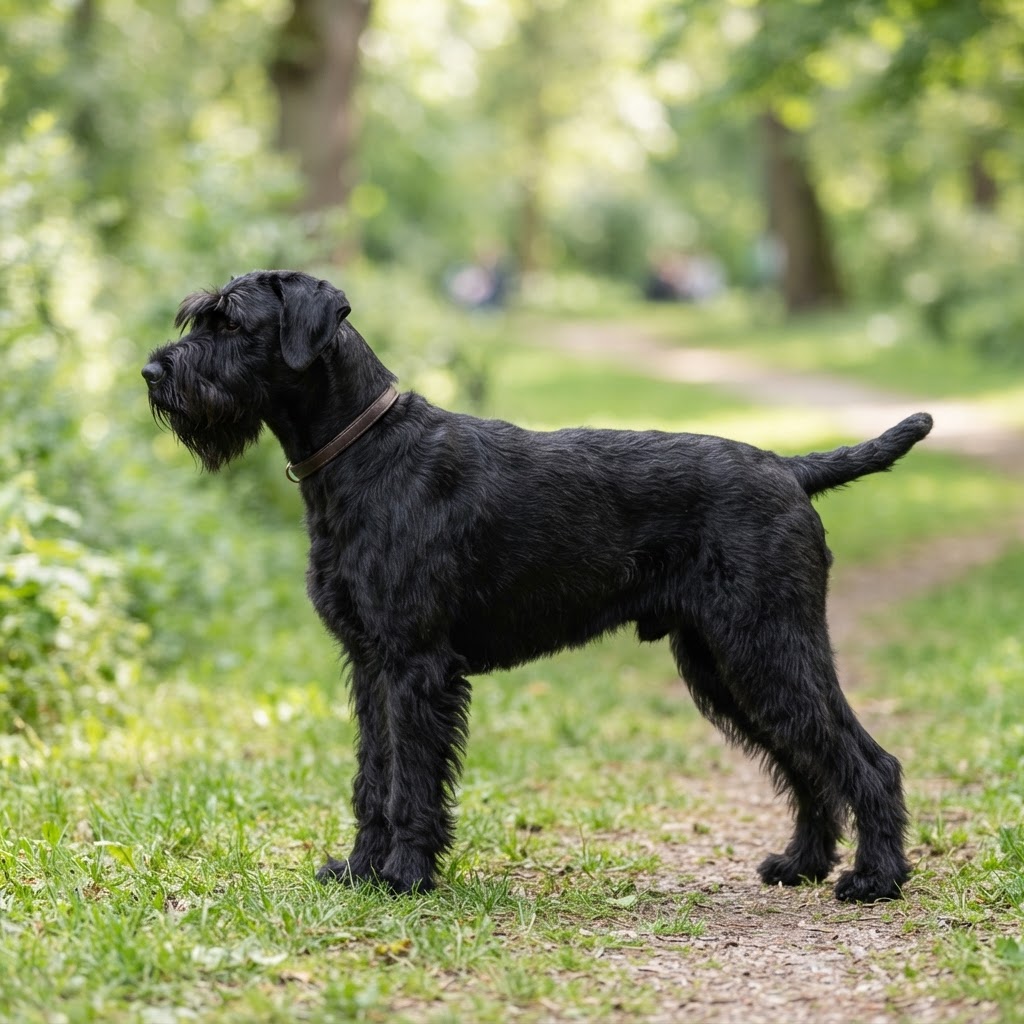
Schnauzer (Giant)
Male: 35-47 kg, Female: 25-35 kg
Male: 65-70 cm, Female: 60-65 cm at the shoulder.
10-12 years
Germany (Bavaria)
About the Schnauzer (Giant)
The Giant Schnauzer is the largest of the three Schnauzer breeds, appearing as a powerful, near-square version of the Standard Schnauzer. Originating in the Bavarian Alps, they were developed as 'the draught dog of the working man,' capable of driving cattle over long distances and protecting the homestead. Their imposing silhouette is defined by a rectangular head, blunt muzzle, and a robust, muscular frame that suggests both speed and endurance. Today, the Giant remains a versatile working dog that demands a job to do. While they are profoundly devoted to their owners, they are often reserved with strangers. They are not merely 'large dogs' but 'intense dogs' that require firm, consistent leadership and early socialization. For an owner prepared for their intelligence and energy, they offer unparalleled protection and companionship, serving as both a formidable guardian and a playful family member.
Breed Standard
Key characteristics from the breed standard
In the show ring, the Giant Schnauzer is a study in powerful symmetry. The breed standard demands a 'square' build where the length of the body equals the height at the withers. Their movement is one of the most distinctive in the Working Group: a free, ground-covering trot with a strong 'drive' from the rear and a long 'reach' in the front. What truly elevates the Giant is their 'sturdy nobility'—an unmistakable combination of a commanding, dark-eyed gaze and an alert, high-headed carriage that radiates self-assurance. Their wiry coat must be meticulously prepared to highlight their muscular transition from the neck to the level topline, making them a breathtaking example of functional elegance.
In Australia
The Giant Schnauzer was introduced to Australia in the late 1970s. In 1979, the first litter was recorded by the Kennel Control Council of Victoria (now Dogs Victoria).
Bred For
Driving livestock (cattle), guarding breweries, and working as police and military dogs.
Temperament
Reliable, intelligent, spirited, and deeply loyal. They possess a natural guarding instinct combined with a composed temperament.
Health Conditions Reported in the Breed
Hip and , (), , and (). They also have a breed-specific predisposition to Squamous Cell Carcinoma (toe cancer), particularly in dark-coated dogs, and urinary stones (urolithiasis).
Exercise Needs
Very high.
Grooming Needs
High. The wiry double coat requires regular brushing (2-3 times weekly) and professional clipping or hand-stripping every 8-12 weeks. Beards must be cleaned daily to prevent 'beard funk' and staining.
Living Suitability
Not suited for apartments. Requires a large, securely fenced yard and thrives when given access to acreage or frequent outdoor work. They need to live indoors with their family to prevent separation distress.
Good with Kids
Generally good with older, respectful children. Their size and exuberant energy may be overwhelming for toddlers or small children.
Good with Other Pets
Can be dominant with other dogs of the same sex. High prey drive means they may chase smaller pets unless raised with them and carefully supervised.
Trainability
Highly intelligent but independent. They are fast learners but will challenge a weak leader. They require firm, positive-reinforcement training and thrive on complex tasks.
Coat & Colours
Hard, wiry, and dense outer coat with a soft undercoat; characterized by the iconic beard and bushy eyebrows.. Pure black or 'pepper and salt'.
Exercise needs vary by age, fitness, health, weather and individual temperament. Consult your veterinarian for an exercise plan appropriate for your dog.
Things to Consider
Every breed has its quirks — here's what to know
Prospective owners should be aware that Giant Schnauzers are prone to Gastric Dilatation-Volvulus (Bloat), a life-threatening condition where the stomach twists; this requires immediate veterinary intervention and mindful feeding practices. They are more likely to develop pancreatitis if fed high-fat diets, so weight and fat intake must be strictly monitored. The 'Schnauzer beard' is a magnet for water, food, and debris, requiring daily cleaning to prevent skin infections or odours. While they are minimal shedders, their grooming is a significant time and financial commitment. As a highly intelligent working breed, they can be prone to separation anxiety if left alone for long periods without a 'job,' leading to destructive chewing. Their natural guarding instinct is strong; they are more likely to be suspicious of strangers, which makes early and ongoing socialisation a non-negotiable requirement to ensure they remain discerning rather than reactive. They are powerful dogs that can be headstrong, but in a home with clear boundaries and plenty of exercise, their devotion is legendary.
Feeding Guide for Your Schnauzer (Giant)
Healthy Weight
32-45 kg
Daily Feeding Amount (general starting estimate)
800-1125 grams
For a Giant Schnauzer, a fresh raw diet should focus on lean proteins to support their muscular build while protecting their pancreas. Adult dogs typically require 2-3% of their ideal body weight daily. Some owners use smaller divided meals and avoid strenuous activity immediately around feeding. These steps cannot guarantee prevention of gastric dilatation-volvulus. Seek urgent veterinary care if bloat is suspected. Ensure a balanced ratio of 70-80% lean muscle meat, 10% edible bone, 10% organ meat, and 10% seasonal vegetables.
Feeding quantities are general starting estimates only. Individual needs vary with body condition, weight trends, age, health and activity. Ingredient percentages alone do not guarantee complete and balanced nutrition — consult a veterinarian for individualised dietary guidance.
Ingredient percentages alone do not guarantee complete and balanced nutrition. Seek veterinary or qualified canine nutrition guidance for individualised dietary advice. Raw feeding, specific proteins or fresh foods should not be presented as preventing, treating or managing breed health conditions without veterinary diagnosis and supervision.
Majestik's Recommended Feeding Approach
Breed Diet Notes
A high-quality, lean protein diet is essential. Due to a breed-specific predisposition to hyperlipidemia and pancreatitis, a diet moderate to low in fat is often recommended. Fresh, raw diets focusing on lean muscle meats are highly beneficial.
A tailored Majestik raw diet should prioritise lean Australian proteins such as Kangaroo or White Fish to manage fat intake and prevent pancreatitis. Lean Beef and Chicken are excellent staples, provided fatty trimmings are minimised. Organ meats should include liver and kidney for essential vitamins, but must be balanced. Include crushed green vegetables (spinach, kelp) for antioxidants. Avoid high-fat treats or table scraps. Given their deep chests, feeding from slightly elevated bowls and ensuring no vigorous exercise an hour before or after meals is a critical management strategy.
These are general breed-level notes only. The appropriate food and serving amount depend on the individual dog's age, health, body condition, activity and tolerance.
Majestik Recommendation
Majestik BARF meals follow our practical 70/10/10/10 approach: approximately 70% quality meat and protein ingredients, 10% edible bone, 10% vegetables and 10% offal. This gives customers a convenient fresh-food option without needing to source and portion every ingredient themselves.
Our Beef, Lamb and Roo BARF meals provide convenient fresh-food options, with suitable proteins chosen or rotated according to the individual dog.
Suitable for different needs
- Healthy adult: Majestik adult Beef, Lamb or Roo BARF meal.
- Puppy: Majestik Premium Puppy.
- Senior: Majestik Senior Blend.
- Working or highly active dog: Suitable Majestik adult meal with quantity adjusted to workload and body condition.
- Protein trial: One Majestik protein at a time.
Recommended Majestik BARF Meals


This is a practical starting recommendation for healthy dogs. Individual needs vary with age, health, body condition and activity.
Schnauzer (Giant) Feeding Calculator
Personalised raw and cooked feeding recommendations based on your dog's profile
Ideal — Ribs palpable without excess fat. Visible waist. Abdominal tuck present.
Have a question about your Schnauzer (Giant)? Dog Health AI
Why Majestik?
Fresh, raw pet food made with integrity in South Australia
Australian Made
Made in Two Wells, South Australia
Freshly Prepared
Real meat, organs, bone & wholefood ingredients
No Fillers
No cheap fillers or artificial preservatives
Family Owned
Locally owned and operated
Local Delivery
Delivery across Adelaide & selected areas
Secure Checkout
Secure payment via Shopify checkout
Subscribe & Save on Schnauzer (Giant) Meals
Get your Schnauzer (Giant)'s fresh and raw meals delivered every two or four weeks. Small subscriptions are combined into a four-week box. Pause, skip or cancel anytime.
Breed Records & Facts
Average Litter Size
5-8 puppies
Schnauzer (Giant) Owner Feedback
Real experiences and tips from Schnauzer (Giant) owners
No reviews yet
Be the first to share your experience with this breed
Other Giant Breeds
References & Sources
Breed information verified against recognised breed authorities and veterinary evidence.