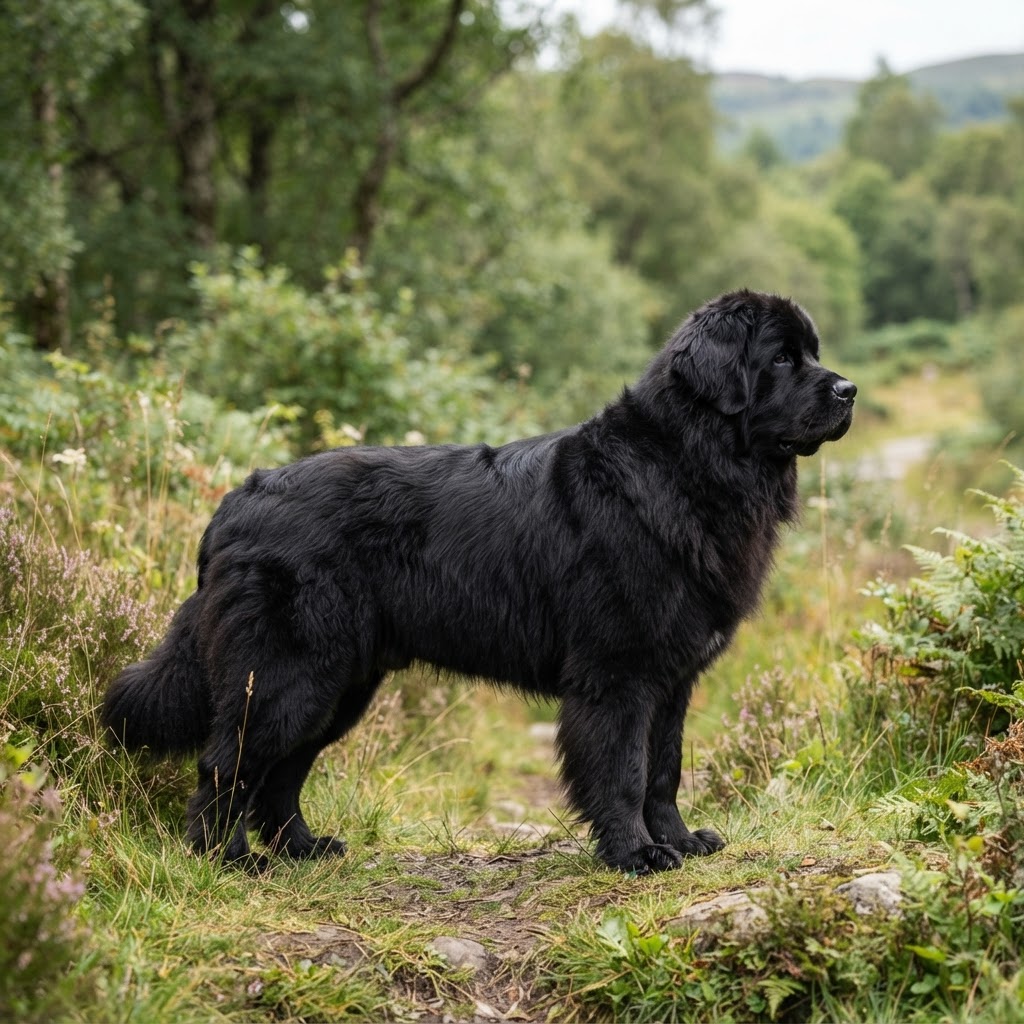
Newfoundland
Male: 64-69 kg, Female: 50-54 kg
Average 66-71 cm at the shoulder
8-10 years
Newfoundland, Canada
About the Newfoundland
The Newfoundland is a magnificent giant breed, originating from the icy waters of Canada where it earned a legendary reputation as a maritime rescue dog. Known as the 'Gentle Giant,' this breed possesses a unique combination of immense physical strength and a profoundly calm, nurturing temperament. Their webbed feet and water-resistant double coat make them peerless swimmers, while their massive frame was historically utilised for heavy carting and haulage tasks on land. Despite their working heritage, they are deeply devoted family companions who thrive on human interaction. Physically, the Newfoundland is characterised by a broad, massive head and a heavy-boned structure that conveys power and endurance. Their expression is soft and intelligent, reflecting a breed that is famously patient with children. In a domestic setting, they are typically low-energy indoors, preferring to lounge near their owners, though their size requires a home with ample floor space. For those prepared for the logistical challenges of a giant, shedding breed, the Newfoundland offers a level of loyalty and gentle companionship that is virtually unmatched in the canine world.
Breed Standard
Key characteristics from the breed standard
In the show ring, the Newfoundland is the embodiment of nautical nobility, presenting a silhouette of immense power softened by a benevolent expression. Judges look for a stately, smooth gait with significant reach and drive, showcasing a well-balanced structure that could theoretically haul nets through a storm. Their coat must be dense and oily to the touch, and their massive head should feature the hallmark deep-set, dark brown eyes.
In Australia
Records indicate Newfoundlands arrived in Australia by the mid-19th century, with the breed being exhibited at the first dog show held in Melbourne in 1864, according to the Newfoundland Club of Victoria.
Bred For
Water rescue, hauling fishing nets, and carting heavy loads such as timber.
Temperament
Renowned for being exceptionally gentle, patient, and courageous, often described as having a 'sweet' disposition.
Health Conditions Reported in the Breed
Hip and , (), (bladder stones), and ().
Exercise Needs
Moderate daily exercise, including walks and, ideally, swimming to maintain muscle mass without overstressing giant-breed joints.
Grooming Needs
Heavy grooming required; daily brushing is necessary to manage the thick double coat and prevent matting, especially during seasonal shedding.
Good with Kids
Excellent; famously patient and protective, earning the nickname 'nanny dog' for their affinity with children of all ages.
Good with Other Pets
Generally very good with other dogs and household pets if socialised early, though their size requires supervision around smaller animals.
Trainability
Highly intelligent and eager to please, though they can be sensitive to harsh corrections; they respond best to consistent, positive-reinforcement training.
Coat & Colours
Flat, water-resistant double coat with a coarse outer layer and soft, dense undercoat.. Black, Brown, and Landseer (white with black markings).
Exercise needs vary by age, fitness, health, weather and individual temperament. Consult your veterinarian for an exercise plan appropriate for your dog.
Things to Consider
Every breed has its quirks — here's what to know
Newfoundlands are predisposed to 'wet mouths,' meaning they will drool, particularly after drinking or when food is nearby; keeping a 'slobber cloth' handy is a standard part of Newfie ownership. Their thick double coats are prone to heavy seasonal shedding and require significant time commitments for grooming to prevent painful matting and 'hot spots.' As a deep-chested giant breed, they are more likely to experience life-threatening Bloat (GDV), so owners must be vigilant about feeding schedules and resting after meals. They are also sensitive to heat; in the Australian climate, they must have access to air conditioning or very cool, shaded areas during summer to prevent heatstroke. Giant breeds are predisposed to joint issues like hip dysplasia and heart conditions such as Subaortic Stenosis, which can mean higher veterinary costs over their lifetime. Additionally, some Newfoundlands may develop digestive sensitivities to standard commercial kibbles containing high grain fillers, often thriving much better on a species-appropriate fresh or raw diet. These challenges are simply part of the package for such a devoted companion—most owners find the 'Newfie slime' a small price to pay for their legendary love.
Feeding Guide for Your Newfoundland
Healthy Weight
50-70 kg
Daily Feeding Amount (general starting estimate)
1,200-1,800 grams
A fresh, raw diet is highly beneficial for Newfoundlands to maintain a lean body condition and support joint health. Focus on high-quality proteins such as beef and lamb, complemented by oily fish for coat maintenance. Some owners use smaller divided meals and avoid strenuous activity immediately around feeding. These steps cannot guarantee prevention of gastric dilatation-volvulus. Seek urgent veterinary care if bloat is suspected.
Feeding quantities are general starting estimates only. Individual needs vary with body condition, weight trends, age, health and activity. Ingredient percentages alone do not guarantee complete and balanced nutrition — consult a veterinarian for individualised dietary guidance.
Ingredient percentages alone do not guarantee complete and balanced nutrition. Seek veterinary or qualified canine nutrition guidance for individualised dietary advice. Raw feeding, specific proteins or fresh foods should not be presented as preventing, treating or managing breed health conditions without veterinary diagnosis and supervision.
Majestik's Recommended Feeding Approach
Breed Diet Notes
High-quality, nutrient-dense diet rich in proteins and omega-3 fatty acids, with strict calorie control to prevent joint-straining weight gain.
An ideal Majestik raw diet for a Newfoundland should feature high-quality proteins like Beef, Lamb, and Kangaroo to provide essential amino acids for muscle maintenance. Incorporating 10% organ meats (liver and kidney) and 10% edible bone is vital for skeletal support. Given their maritime history, including Majestik's fish-based options provides crucial Omega-3 fatty acids for skin health and a lustrous, water-resistant coat. Glucosamine-rich additions like chicken feet or beef trachea can further assist in long-term joint health for this giant breed.
These are general breed-level notes only. The appropriate food and serving amount depend on the individual dog's age, health, body condition, activity and tolerance.
Majestik Recommendation
Majestik BARF meals follow our practical 70/10/10/10 approach: approximately 70% quality meat and protein ingredients, 10% edible bone, 10% vegetables and 10% offal. This gives customers a convenient fresh-food option without needing to source and portion every ingredient themselves.
Our Beef, Lamb and Roo BARF meals provide convenient fresh-food options, with suitable proteins chosen or rotated according to the individual dog.
Suitable for different needs
- Healthy adult: Majestik adult Beef, Lamb or Roo BARF meal.
- Puppy: Majestik Premium Puppy.
- Senior: Majestik Senior Blend.
- Working or highly active dog: Suitable Majestik adult meal with quantity adjusted to workload and body condition.
- Protein trial: One Majestik protein at a time.
Recommended Majestik BARF Meals


This is a practical starting recommendation for healthy dogs. Individual needs vary with age, health, body condition and activity.
Newfoundland Feeding Calculator
Personalised raw and cooked feeding recommendations based on your dog's profile
Ideal — Ribs palpable without excess fat. Visible waist. Abdominal tuck present.
Have a question about your Newfoundland? Dog Health AI
Why Majestik?
Fresh, raw pet food made with integrity in South Australia
Australian Made
Made in Two Wells, South Australia
Freshly Prepared
Real meat, organs, bone & wholefood ingredients
No Fillers
No cheap fillers or artificial preservatives
Family Owned
Locally owned and operated
Local Delivery
Delivery across Adelaide & selected areas
Secure Checkout
Secure payment via Shopify checkout
Subscribe & Save on Newfoundland Meals
Get your Newfoundland's fresh and raw meals delivered every two or four weeks. Small subscriptions are combined into a four-week box. Pause, skip or cancel anytime.
Breed Records & Facts
Average Litter Size
4-12 puppies
Newfoundland Owner Feedback
Real experiences and tips from Newfoundland owners
No reviews yet
Be the first to share your experience with this breed
Other Giant Breeds
References & Sources
Breed information verified against recognised breed authorities and veterinary evidence.