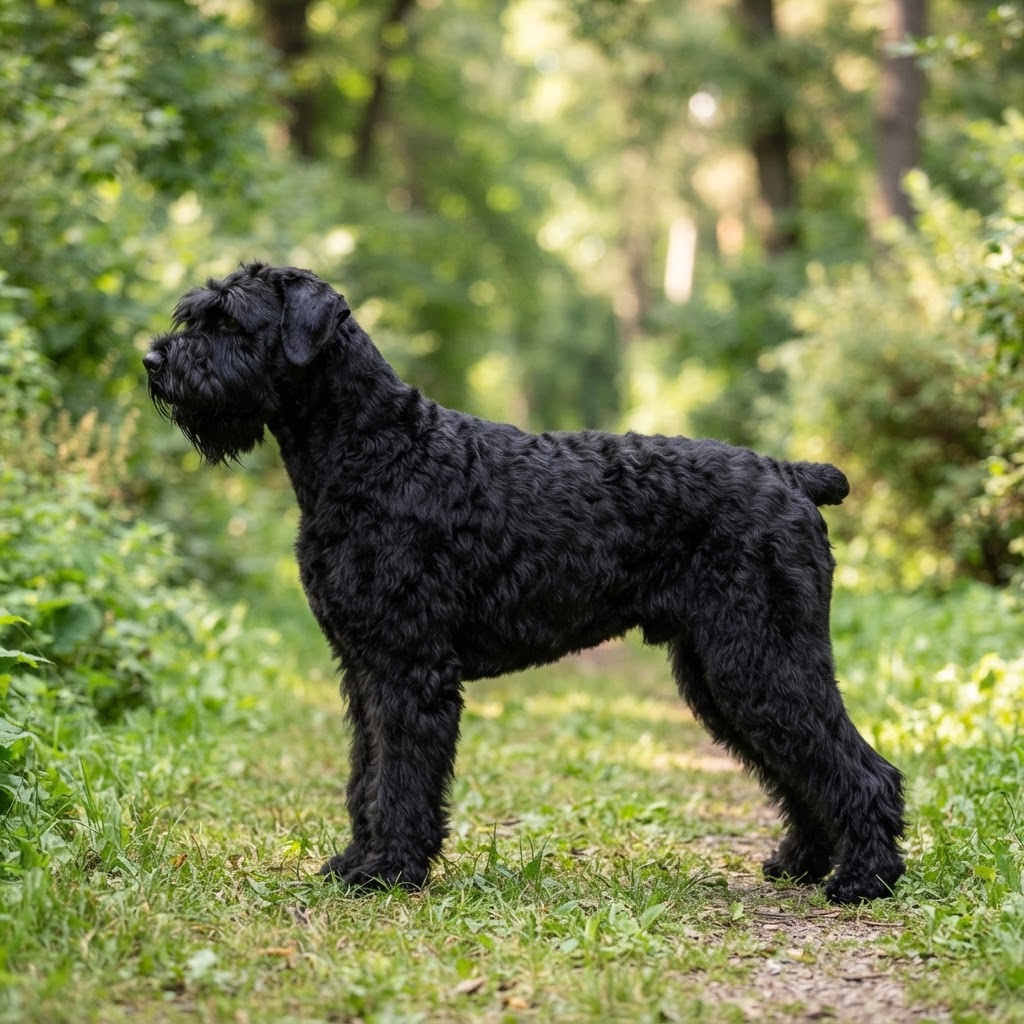
Russian Black Terrier
Male: 50-60 kg, Female: 45-50 kg
Male: 72-76 cm, Female: 68-72 cm at the shoulder
10-12 years
Russia (Soviet Union)
About the Russian Black Terrier
The Russian Black Terrier, often called the 'Black Pearl of Russia,' is an imposing and powerful giant breed created through a sophisticated cross-breeding program involving the Giant Schnauzer, Rottweiler, Airedale Terrier, and Newfoundland. Unlike many other working breeds, they were designed specifically for reliability and versatility in extreme climates, serving as steadfast guardians and military companions. They possess a robust, square-proportioned build and a distinctive 'shaggy' appearance that belies their agility and speed. In a domestic setting, the Russian Black Terrier is a 'velcro dog' that thrives on human companionship and requires inclusion in all family activities. They are not suited for life in a kennel or isolated backyard; they need consistent leadership and early socialization to manage their natural protective instincts. For an experienced owner, they offer an unparalleled blend of guardian-like vigilance and gentle, soulful companionship.
Breed Standard
Key characteristics from the breed standard
In the show ring, the Russian Black Terrier must present a silhouette of massive power and dignified stability. Their movement is a hallmark of the breed: a free, smooth, and well-coordinated trot with powerful drive from the hindquarters and significant reach in the forequarters. Unlike more delicate terriers, their substance is significant, characterized by a deep chest and a well-muscled neck.
In Australia
The Black Russian Terrier was introduced to Australia in the early 2000s, with the first pair arriving in late 2001. Following this arrival, the Black Russian Terrier was officially recognized by the Australian National Kennel Council (ANKC) in 2002.
Bred For
Developed by the Soviet military at the Red Star Kennel for guard work, border patrol, and military utility tasks.
Temperament
Intelligent, confident, courageous, and deeply loyal. They are naturally protective and reserved with strangers but exceptionally devoted to their families.
Health Conditions Reported in the Breed
Hip and , Juvenile Laryngeal Paralysis and Polyneuropathy (JLPP), Hyperuricosuria (HUU), (), and .
Exercise Needs
Significant daily physical and mental stimulation required, typically 60-90 minutes of active walking, hiking, or training exercises.
Grooming Needs
High; requires weekly brushing to prevent matting, professional clipping every 6-8 weeks, and regular beard cleaning to maintain hygiene.
Living Suitability
Suited to homes with a medium to large securely fenced yard. They are generally too large and human-oriented for small apartment living unless exceptionally well-exercised daily.
Good with Kids
Generally very good and patient with children in their own family, though their size requires supervision with toddlers.
Good with Other Pets
Can be dominant with other dogs of the same sex; usually good with other household pets if raised with them from a young age.
Trainability
Highly intelligent and eager to work, but possess an independent streak. They require firm, consistent, and positive reinforcement-based training.
Coat & Colours
Double coat; thick, coarse, slightly wavy outer coat with a soft, dense undercoat.. Black, or black with insignificant scattered grey hairs.
Exercise needs vary by age, fitness, health, weather and individual temperament. Consult your veterinarian for an exercise plan appropriate for your dog.
Things to Consider
Every breed has its quirks — here's what to know
Prospective owners should be prepared for the 'wet beard' phenomenon—the RBT’s facial furnishings often trap water and food, which they may then deposit around the home. While they are minimal shedders, their coat is prone to heavy matting if not brushed thoroughly to the skin at least twice a week. Like many giant, deep-chested breeds, they are more likely to experience Gastric Dilatation-Volvulus (Bloat), which is a life-threatening emergency; feeding smaller, frequent meals and avoiding vigorous exercise around meal times can help manage this risk. They are also predisposed to joint issues such as hip and elbow dysplasia, making weight management and appropriate exercise surfaces critical during their growth phase. Some individuals may be prone to Hyperuricosuria (HUU), which can lead to the formation of painful bladder stones on high-purine diets—this doesn't mean every RBT will develop stones, but it is a known breed sensitivity to monitor via veterinary testing. Additionally, their strong guarding instinct means they can be overly protective if not properly socialized from puppyhood, though this same trait makes them exceptionally devoted family protectors.
Feeding Guide for Your Russian Black Terrier
Healthy Weight
45-60 kg
Daily Feeding Amount (general starting estimate)
1125-1650 grams per day
Based on a weight of 50-55 kg, they require approximately 1100g to 1600g of fresh food per day. Majestik's Kangaroo and Beef options provide excellent lean protein bases, while Salmon additions can support their dense double coat.
Feeding quantities are general starting estimates only. Individual needs vary with body condition, weight trends, age, health and activity. Ingredient percentages alone do not guarantee complete and balanced nutrition — consult a veterinarian for individualised dietary guidance.
Ingredient percentages alone do not guarantee complete and balanced nutrition. Seek veterinary or qualified canine nutrition guidance for individualised dietary advice. Raw feeding, specific proteins or fresh foods should not be presented as preventing, treating or managing breed health conditions without veterinary diagnosis and supervision.
Majestik's Recommended Feeding Approach
Breed Diet Notes
A high-quality diet rich in animal proteins and fats to support muscle mass and joint health. Fresh or raw diets are highly effective, particularly those emphasizing low-purine proteins for dogs predisposed to HUU.
The ideal raw diet for a Russian Black Terrier should feature Majestik Beef or Lamb as primary protein sources to maintain substantial muscle. Because of the breed's predisposition to Hyperuricosuria (HUU), owners should opt for lower-purine selections like Majestik Chicken or Kangaroo if the dog is a known carrier or affected. The diet should include raw meaty bones (like turkey necks or lamb ribs) for dental health and 10-15% pureed green vegetables to mimic natural foraging. Ensure organ intake (liver/kidney) is strictly balanced to manage purine levels while providing essential Vitamin A and D.
These are general breed-level notes only. The appropriate food and serving amount depend on the individual dog's age, health, body condition, activity and tolerance.
Majestik Recommendation
Majestik BARF meals follow our practical 70/10/10/10 approach: approximately 70% quality meat and protein ingredients, 10% edible bone, 10% vegetables and 10% offal. This gives customers a convenient fresh-food option without needing to source and portion every ingredient themselves.
Our Beef, Lamb and Roo BARF meals provide convenient fresh-food options, with suitable proteins chosen or rotated according to the individual dog.
Suitable for different needs
- Healthy adult: Majestik adult Beef, Lamb or Roo BARF meal.
- Puppy: Majestik Premium Puppy.
- Senior: Majestik Senior Blend.
- Working or highly active dog: Suitable Majestik adult meal with quantity adjusted to workload and body condition.
- Protein trial: One Majestik protein at a time.
Recommended Majestik BARF Meals


This is a practical starting recommendation for healthy dogs. Individual needs vary with age, health, body condition and activity.
Russian Black Terrier Feeding Calculator
Personalised raw and cooked feeding recommendations based on your dog's profile
Ideal — Ribs palpable without excess fat. Visible waist. Abdominal tuck present.
Have a question about your Russian Black Terrier? Dog Health AI
Why Majestik?
Fresh, raw pet food made with integrity in South Australia
Australian Made
Made in Two Wells, South Australia
Freshly Prepared
Real meat, organs, bone & wholefood ingredients
No Fillers
No cheap fillers or artificial preservatives
Family Owned
Locally owned and operated
Local Delivery
Delivery across Adelaide & selected areas
Secure Checkout
Secure payment via Shopify checkout
Subscribe & Save on Russian Black Terrier Meals
Get your Russian Black Terrier's fresh and raw meals delivered every two or four weeks. Small subscriptions are combined into a four-week box. Pause, skip or cancel anytime.
Breed Records & Facts
Average Litter Size
6-10 puppies
Russian Black Terrier Owner Feedback
Real experiences and tips from Russian Black Terrier owners
No reviews yet
Be the first to share your experience with this breed
Other Giant Breeds
References & Sources
Breed information verified against recognised breed authorities and veterinary evidence.